1971, a time of great building works
In Paris, 1971 saw the fall of the first six Baltard pavilions of the old Les Halles market, demolished to make way for the RER station and the Forum. Far from the capital, in the South West, Gascon winegrowers brought in their grapes as they did every autumn. No reliable climate record allows us to describe the 1971 harvest in Armagnac precisely, and we will not invent one. What we do know, on the other hand, is what the houses made of these brandies: decades of ageing, then a bottling decided by the cellar master.
Four houses for a 1971 vintage
The selection is short, because old vintages are becoming rare: every cask that is emptied will never be replaced. Here are the bottles we offer:
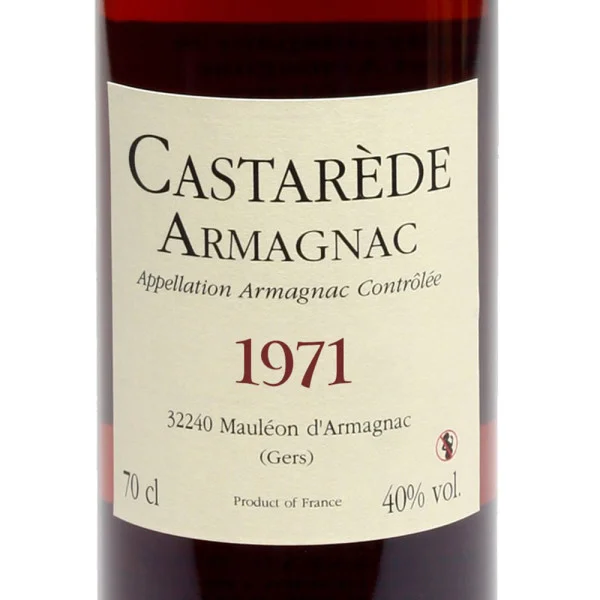
- Armagnac Castarède, a family house founded in 1832, still independent and run from Château de Maniban, in Bas-Armagnac: its 1971 spent 49 years in cask before being bottled in 2020, at 40% ABV. The house describes it as powerful and complex, with a range of aromas that reveals itself once the armagnac has been well aired and warmed in the glass;
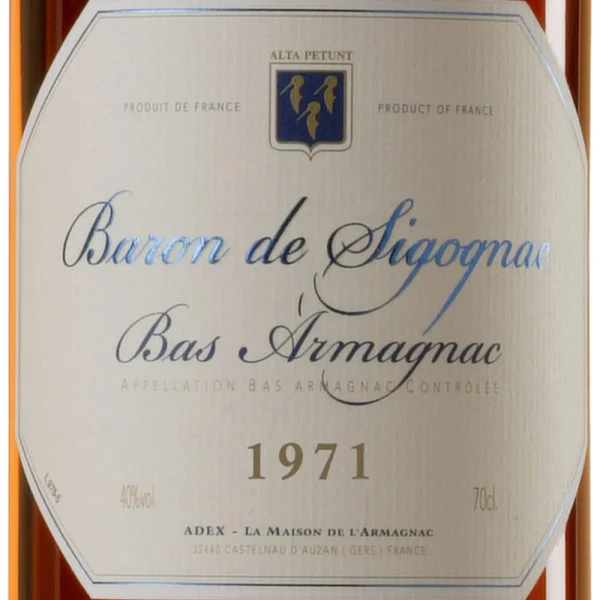
- Baron de Sigognac, from the Guasch family, who distil at Château de Bordeneuve on an almost century-old short copper column still and age each vintage separately, in Bas-Armagnac: mahogany colour, complex and very elegant candied fruit, a round and powerful attack, spicy oak and then a finish of prune. 40% ABV, ugni blanc and baco grapes;
- Clés des Ducs, distilled in Panjas: an unblended vintage, chosen cask by cask to produce a long, smooth armagnac, with deliberately discreet ageing that preserves the typicity of the vintage. 40% ABV;
- Jean Cavé, a family of distillers based in Lannepax, in Bas-Armagnac, since 1883: a brut de fût at 49.6% ABV, bottled at its natural strength.
Brut de fût or 40%: what is the difference?
Three of our 1971s were brought down to 40% ABV very gradually, a step that softens the spirit and makes it easier to taste. The fourth, from Jean Cavé, is a brut de fût armagnac: it is bottled at the strength it reached naturally in the cask, here 49.6%. More concentrated and more powerful, it is for the connoisseur who likes to take time to let the glass open up, and it is savoured very slowly. For a gift to someone discovering old armagnac, a 1971 at 40% remains the safest choice.
From vineyard to cellar: how a vintage armagnac is born
It all starts in the Gascon vineyard. The grape varieties permitted in the Armagnac appellation are mainly ugni blanc, baco, folle blanche and colombard. Folle blanche, a historic variety of the region, gives fine, floral brandies; ugni blanc brings freshness, baco roundness on the palate. Depending on each estate's tradition, one variety is chosen alone or they are combined in the vineyard. Harvested in autumn, they give a light, acidic white wine that is not meant to be drunk: it is used only for distillation.
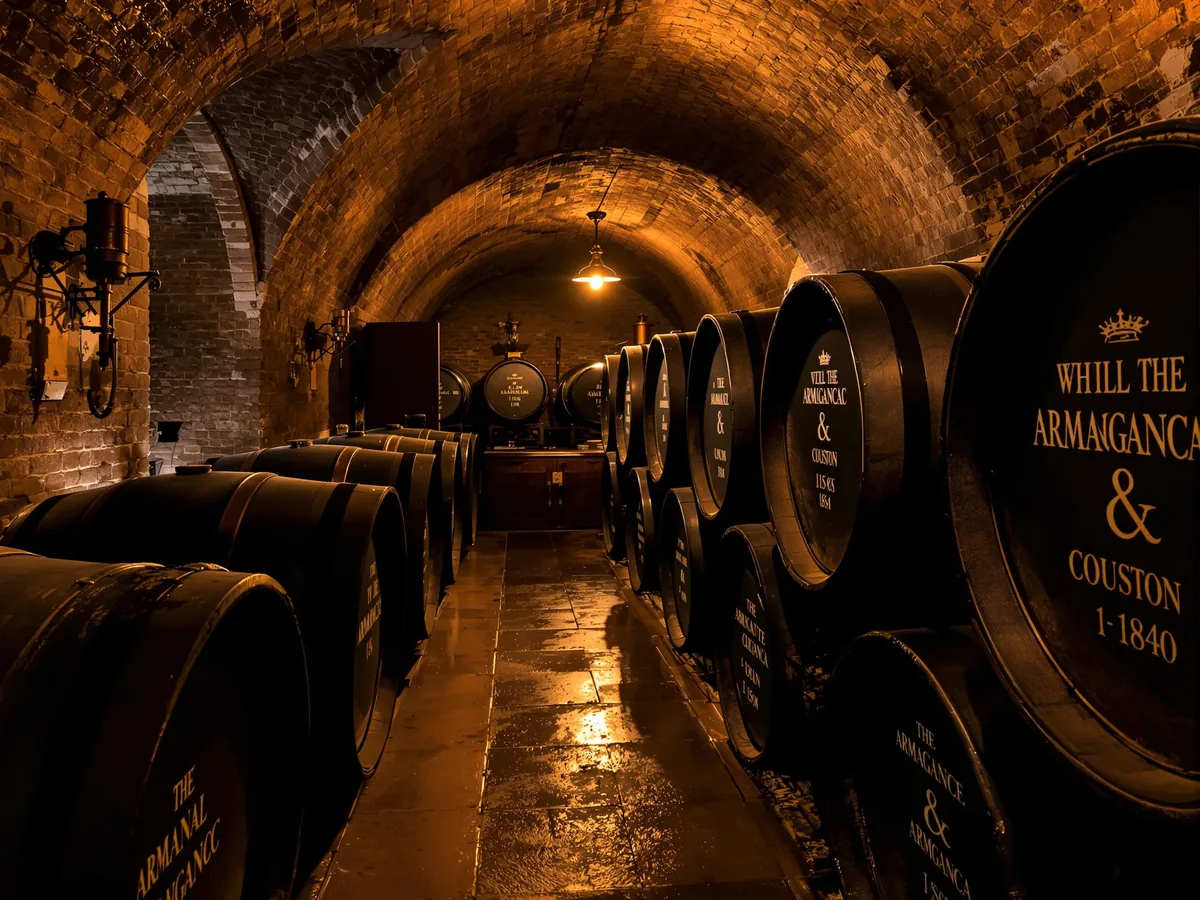
Distillation takes place during the winter, in the armagnac still, a continuous still. This is a real difference from cognac, which is distilled twice: armagnac comes out in a single pass, which keeps more of the character of the grape and the terroir. The brandy, colourless as it leaves the still, then goes into a barrel.
Then ageing begins. The cask gives it its colour, its tannins and notes of vanilla; the air passing through the staves makes it evolve slowly, while part of the alcohol evaporates. For a 1971, this work lasted decades: 49 years for the Castarède, for example. Once bottled, armagnac no longer ages: the bottling date therefore gives the real age of the brandy.
A vintage uses only the grapes of a single autumn, without blending. This is what sets it apart from an XO or a hors d'âge, where several ages are married to achieve a consistent style. With a 1971, you are not buying a house style: you are buying a precise date.
The aromas of a 55 year old armagnac
After such long ageing, an old armagnac takes on a deep colour, often mahogany. Notes frequently found at this age: candied fruit, prune, walnut, orange peel, cocoa or chocolate, cinnamon, wax, and sometimes the rancio so prized in very old brandies. The palate is broad, the finish long and warming. Their colour and aromas keep evolving in the glass, from lively notes towards oak and deeper scents. Each house nevertheless keeps its signature: power and complexity at Castarède, roundness and prune at Baron de Sigognac, smoothness and discreet oak for the vintage distilled in Panjas, intensity at Jean Cavé.
How to taste a 1971 armagnac
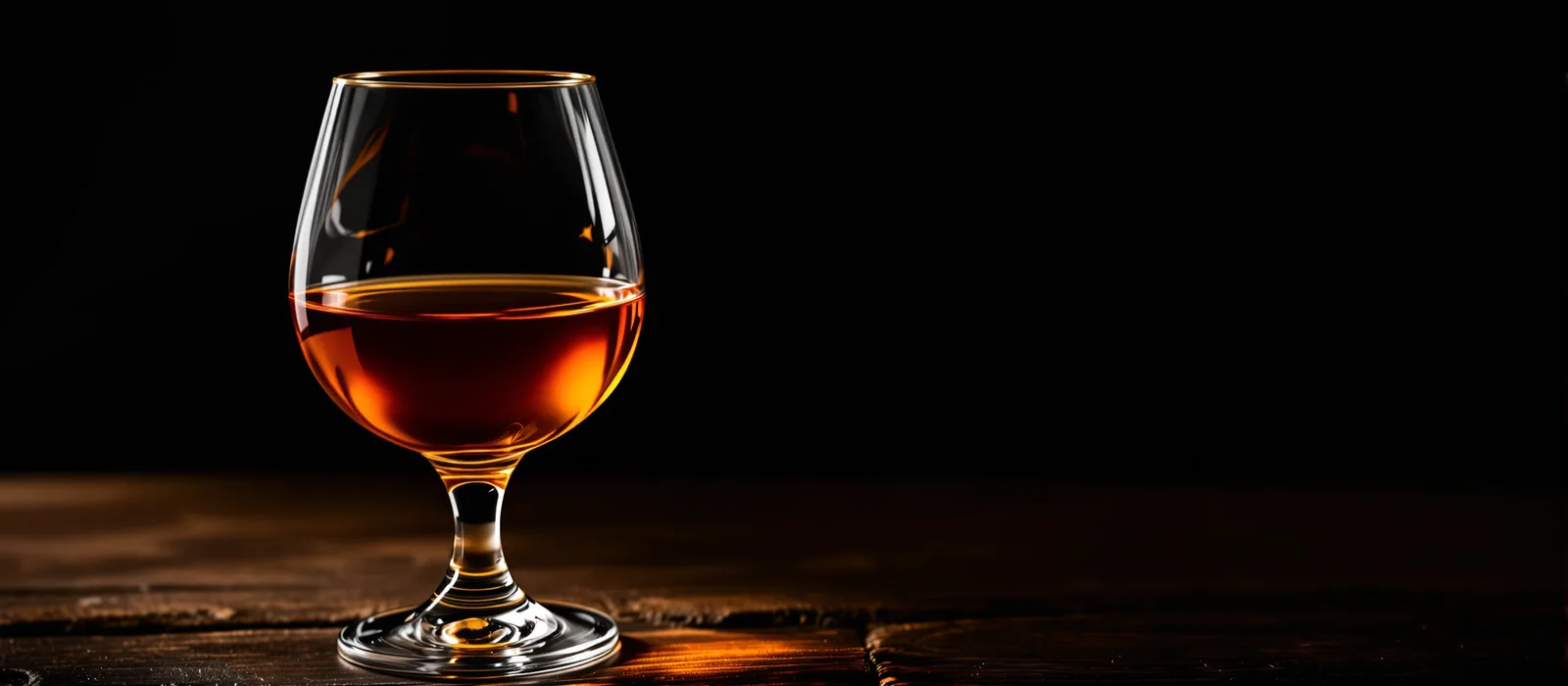
Choose a tulip glass and pour a small amount at room temperature, never over ice. First look at the colour, then breathe it in gently: the first impressions, often the most vivid, soon give way to others. Then let the glass rest for a few minutes and warm it in your hand; as Castarède advises for its 1971, this is how the aromas truly open up. Then take one sip at a time, held for a moment. A square of dark chocolate goes well with it. An empty glass left on the table still scents the room long afterwards.
Store the bottle upright, away from light and changes in temperature. Once opened, it keeps for several months; unopened, it goes through the years without losing its quality.
55th birthday or emerald wedding anniversary: giving the year 1971
In 2026, people born in 1971 celebrate their 55th birthday and couples married in 1971 their emerald wedding anniversary. Giving an armagnac from their vintage means giving a spirit that has lived through the same history as they have, patiently, in a Gascon cellar. A unique gift, to share on the evening of the celebration, or to keep in a collection for another important moment. For a nearby anniversary, other vintages have their own page, such as the 1966 vintage or the 1976 vintage.
Frequently asked questions about 1971 armagnac
How much does a 1971 armagnac cost?
The price depends on the house, the strength (40% or brut de fût) and the rarity of the lot: a Jean Cavé brut de fût and a Castarède at 40% do not answer the same wishes. All come in 70 cl, and each product page shows the price and the house: compare the four bottles to choose according to your budget.
What are the characteristics of the 1971 armagnac?
A brandy from a single harvest, aged for several decades: dark colour, notes of prune and candied fruit, a broad palate, a long finish. The style varies with the estate and the strength.
What is the best 1971 armagnac?
The one that suits the taste of the person drinking it: softness and roundness with a 40%, power with the brut de fût. If in doubt, our customer service will help you choose.
Which grape varieties are used for the 1971 armagnac?
At Baron de Sigognac, ugni blanc and baco. The other houses do not specify the grape varieties for this vintage; the appellation permits in particular ugni blanc, baco, folle blanche and colombard.
Who are the producers of 1971 armagnac?
On our site: Castarède, Baron de Sigognac (made at Château de Bordeneuve), Clés des Ducs and Jean Cavé, four great names of Gascon armagnac.
Where can I buy a 1971 armagnac online?
At Plaisirs de Gascogne, an online shop specialising in vintage armagnac: simple ordering (add the bottle to your basket, we take care of the rest), secure payment and careful shipping, in protective packaging, in France and across Europe.
Find all our vintage armagnacs from every era.
Please enjoy responsibly. Excessive alcohol consumption is harmful to health.



 Jean Cavé
113 bottles
Jean Cavé
113 bottles
 Armagnac Delord
92 bottles
Armagnac Delord
92 bottles
 Château de Millet
79 bottles
Château de Millet
79 bottles
 Dartigalongue
76 bottles
Dartigalongue
76 bottles
 Baron de Sigognac
69 bottles
Baron de Sigognac
69 bottles
 Armagnac Castarède
63 bottles
Armagnac Castarède
63 bottles
 Clés des Ducs
48 bottles
Clés des Ducs
48 bottles
 Château de Laubade
43 bottles
Château de Laubade
43 bottles
 Domaine de Pellehaut
28 bottles
Domaine de Pellehaut
28 bottles
 Château de Bordeneuve
17 bottles
Château de Bordeneuve
17 bottles
 Charles de Granville
13 bottles
Charles de Granville
13 bottles
 Domaine de Danis
7 bottles
Domaine de Danis
7 bottles