The principle of a vintage armagnac
A vintage, in armagnac, refers to a single harvest. All the brandy in the bottle comes from the 1929 harvest: no other year has been added. A VSOP, an XO or a hors d'âge are blends, in which several ages complement one another to give a consistent taste. A 1929 vintage makes the opposite choice: that of a single season, with its own character.
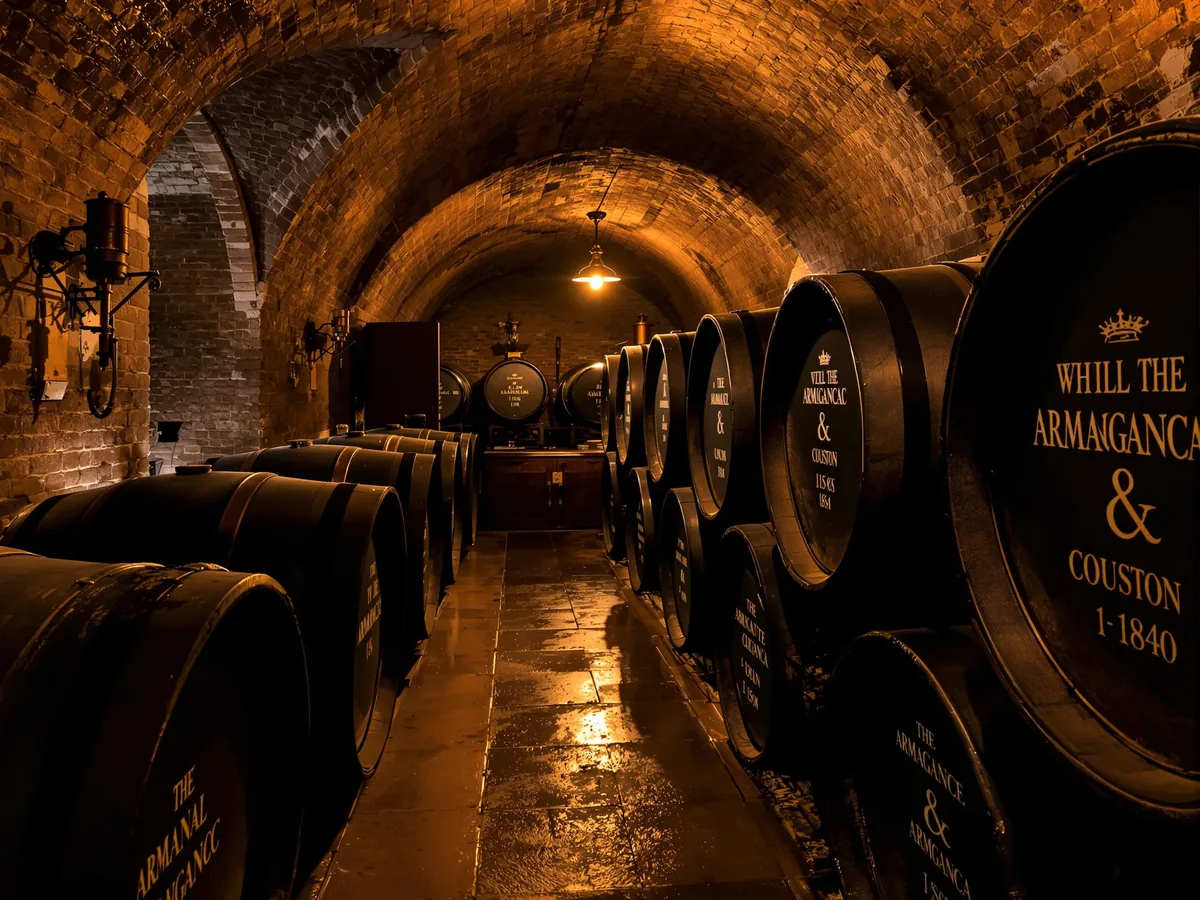
Keeping such a lot for nearly a century is anything but obvious. It takes space in the cellar, patience, and a willingness to watch the level fall every year through evaporation. The rare 1929 bottles that still exist are the fruit of this constancy.
1929, from Tintin to Black Thursday
On 10 January 1929, a young reporter with a quiff made his first appearance in Le Petit Vingtième, the children's supplement of a Belgian daily newspaper: Tintin was born, from the pen of Hergé (source: Wikipedia, article "Tintin au pays des Soviets"). In the autumn, on 24 October, the New York Stock Exchange collapsed: this was Black Thursday, the starting point of the Great Depression (source: Wikipedia, article "Krach de 1929"). In Gascony, that same year, the vines gave the harvest that would be distilled the following winter. On the quality of this harvest, we found no producer source, so we do not characterise it.
Our bottles of 1929 armagnac
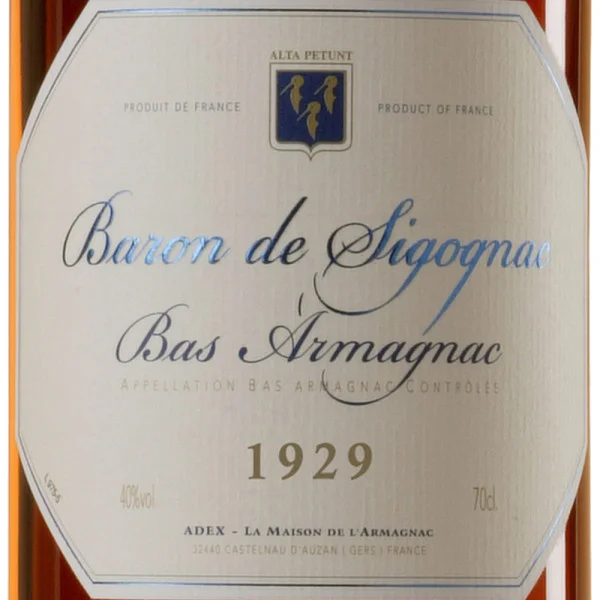
- Baron de Sigognac: a 1929 at 40% ABV, from ugni blanc and baco, kept at Château de Bordeneuve, where each vintage ages in its own cask. The house prepares its bottles to order and shows the bottling date on the back. It does not publish a tasting note for 1929;
- Jean Cavé: a 1929 Bas-Armagnac AOP, without any blending, from the house's collection of old vintages. Bottled brut de fût, it keeps its natural strength, which you will find on the label. Presented in a wooden box.
A reduced armagnac, supple and approachable, and an armagnac at its original strength, more intense: two ways to discover 1929. Lovers of the second style will find other years among our brut de fût armagnacs.
Two Bas-Armagnac families
Winegrower, distiller and cellar master, Jean Cavé founded his house in Lannepax, in the Gers, in 1883. Four generations later, Henri Cavé upholds the tradition of continuous distillation and a collection of old vintages among the richest in the appellation. The oldest brandies rest in demijohns in the paradis, that part of the cellar reserved for the house's treasures.
Château de Bordeneuve, near Eauze, has belonged since 1974 to the Guasch family, who age the Baron de Sigognac armagnacs there. Production remains confidential, and the estate keeps years dating back to 1893. The house describes its style as round and fruity, with notes of toasted dried fruit, coffee and dark chocolate that grow more pronounced with age.
For more recent vintages, our shop brings together other houses of the South West: Castarède, Château de Laubade, Château de Millet, Delord, Dartigalongue and Domaine de Pellehaut.
How it is made, in brief
Armagnac is a wine brandy. The appellation's grape varieties are ugni blanc, baco, folle blanche and colombard; folle blanche, a historic grape variety, is rarer today than ugni blanc. The wine is distilled just once, continuously, in the armagnac still; cognac, by comparison, is distilled twice. The brandy then ages in oak casks, where it takes on its colour, its tannins and its aromas, while the alcohol gently evaporates. Once in the bottle, it no longer changes.
Three terroirs make up the appellation: Bas-Armagnac, Ténarèze and Haut-Armagnac. Our two 1929s are Bas-Armagnacs, a terroir of tawny sands renowned for its fine brandies.
Tasting a 97-year-old armagnac
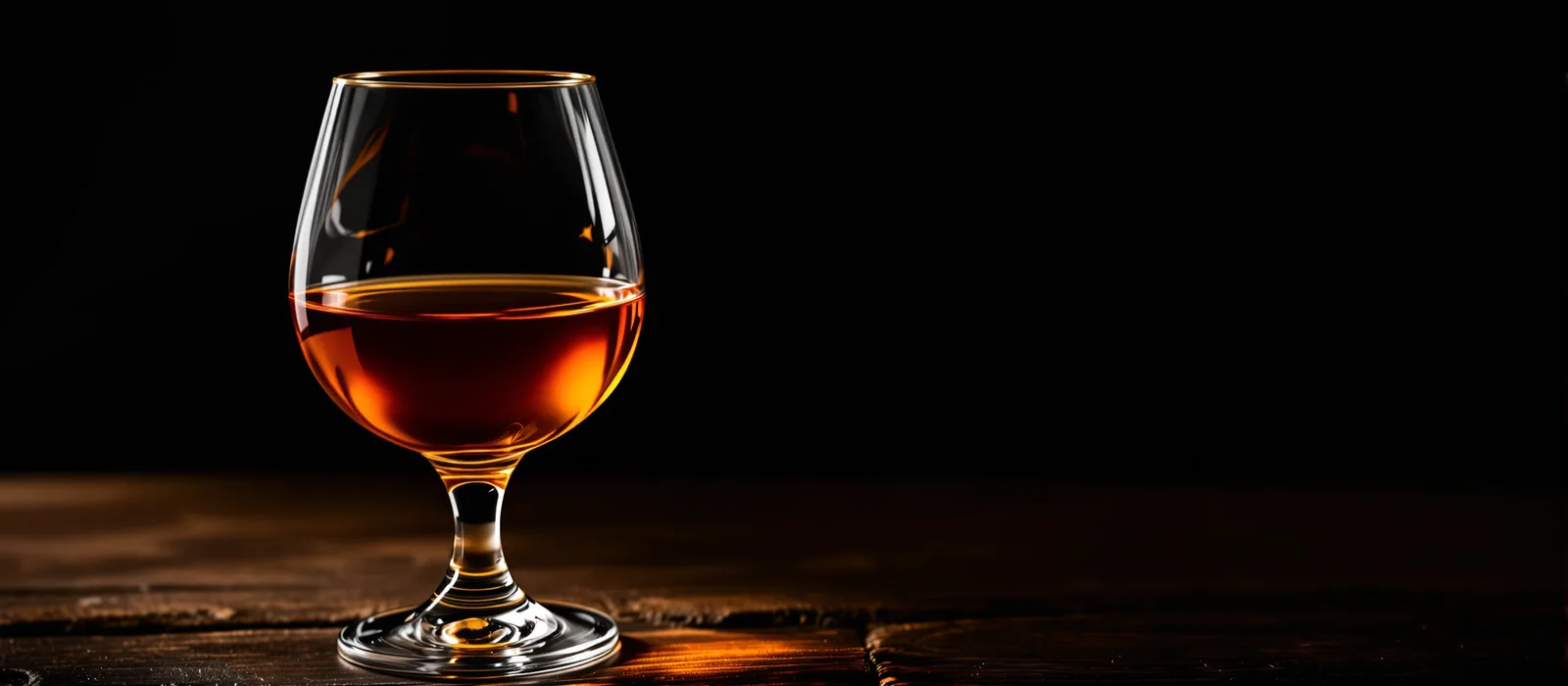
Choose a tulip glass and pour in a splash of armagnac, at room temperature. Wait ten minutes or so: the brandy opens up on contact with the air. Armagnacs of this age often offer aromas of prune, walnut, cocoa, leather or spices, sometimes a note of rancio; but the bottle will have the last word. For the brut de fût, a drop of water can soften the attack, according to your preference.
Store the bottle upright, somewhere cool and away from light: unopened, it will keep for a long time, and opened, for several months.
Old armagnac: buying online without worry
Buying an old vintage calls for trust. In our shop, each product page specifies the house, château or estate of origin, the bottle size and the alcohol content. Ordering is simple: you add the bottle to your basket, pay securely, and it ships to France or elsewhere in Europe, in packaging designed for fragile bottles. Our terms of sale can be consulted at any time, and our customer service team answers before and after your purchase. Château de Bordeneuve, Château de Laubade, Château de Millet: each house in our shop has its own page, to help you get to know its old armagnacs.
A 1929 to give
In 2026, a 1929 armagnac celebrates the 97th birthday of those born that year. It is also an original gift for a Tintin fan, an enthusiast of economics or history, or for the anniversary of a house founded in 1929. In a series of old years, it slots in between our 1928 armagnac and our 1930 armagnac.
Your questions about 1929 armagnac
What is the price of a 1929 armagnac?
It depends on the house and the method of bottling. Each product page shows the price, the bottle size and the strength.
Where can I buy a 1929 armagnac?
At Plaisirs de Gascogne, an online shop dedicated to vintage armagnac: add to basket, secure payment, careful delivery in France and across Europe, and a customer service team ready to advise you.
Which producers offer a 1929 armagnac?
Baron de Sigognac and Jean Cavé, two Bas-Armagnac houses, in our selection.
What are the characteristics of the 1929 armagnac?
Two 70 cl bottles from a single harvest: a Sigognac at 40% ABV, from ugni blanc and baco, and a Jean Cavé brut de fût, unblended, in a wooden box.
What is the history of the 1929 armagnac?
That of a wine harvested in the year of the Crash, distilled the following winter, then kept for nearly a century by two Gascon families.
Browse all our vintage armagnacs, year by year.
Please enjoy responsibly. Excessive alcohol consumption is harmful to health.



 Jean Cavé
113 bottles
Jean Cavé
113 bottles
 Armagnac Delord
92 bottles
Armagnac Delord
92 bottles
 Château de Millet
79 bottles
Château de Millet
79 bottles
 Dartigalongue
76 bottles
Dartigalongue
76 bottles
 Baron de Sigognac
69 bottles
Baron de Sigognac
69 bottles
 Armagnac Castarède
63 bottles
Armagnac Castarède
63 bottles
 Clés des Ducs
48 bottles
Clés des Ducs
48 bottles
 Château de Laubade
43 bottles
Château de Laubade
43 bottles
 Domaine de Pellehaut
28 bottles
Domaine de Pellehaut
28 bottles
 Château de Bordeneuve
17 bottles
Château de Bordeneuve
17 bottles
 Charles de Granville
13 bottles
Charles de Granville
13 bottles
 Roger Groult
7 bottles
Roger Groult
7 bottles