An old 1918 armagnac, witness to a turning point
Holding a 1918 armagnac means holding a harvest picked while the Great War was not yet over. A vintage armagnac contains only one harvest, that of the year written on the label. It is not mixed with other brandies, unlike a VSOP, an XO or a hors d'âge, which are blends of several ages. This is what English speakers call a vintage armagnac: the memory of a single season, and of a single cellar.
For a bottle like this to reach us, several generations had to keep this lot untouched for more than a hundred years. It is this patience, far more than the figure on the label, that gives a great old armagnac its value.
1918, the year of the Armistice
On 11 November 1918, between 5.12 and 5.20 in the morning, the Armistice was signed in the railway carriage of Marshal Foch's train, stationed in the clearing of Rethondes, in the forest of Compiègne; the ceasefire took effect at 11 o'clock (source: Wikipedia, article "Armistice de 1918"). In the countryside of the Gers, as everywhere in France, it was often women, the elderly and children who kept the farms going during the war. We have no producer source on the 1918 harvest in Gascony, so we pass no judgement on its quality.
Our two 1918 armagnacs
The two bottles on this page come from Bas-Armagnac, in 70 cl bottles presented in a wooden case. Two houses, two ways of putting a century into a bottle:
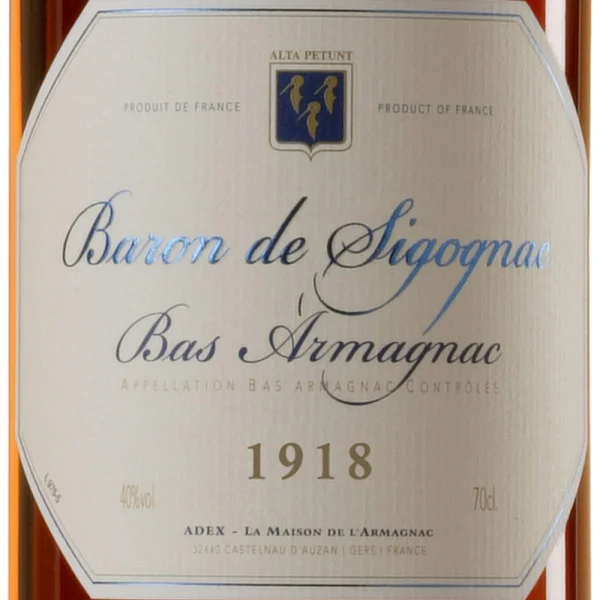
- Baron de Sigognac: a 1918 at 40% ABV, from ugni blanc and baco, kept at Château de Bordeneuve, in Castelnau d'Auzan. The estate ages each year separately there and keeps vintages dating back to 1893. According to the house, the bottling date is shown on the back of each bottle, a valuable guide to the time actually spent in wood;
- Jean Cavé: a 1918 brut de fût, from the collection of old vintages of this Lannepax house, founded in 1883 and now run by Henri Cavé, the fourth generation. The label bears the words Bas-Armagnac AOP. The brandy has never been blended and keeps, in the bottle, its natural strength, with no added water.
The first, brought down to 40% ABV, is the most approachable; the second, a brut de fût armagnac, is for those who want to taste the brandy as it was in the cellar.
How a vintage armagnac is made
Armagnac is the brandy of Gascony, in the South West. Its appellation is divided between three terroirs: Bas-Armagnac, Ténarèze and Haut-Armagnac. The base wine is a dry white, made mainly from ugni blanc, baco, folle blanche and colombard. Folle blanche is one of the historic grape varieties of Gascony; Bas-Armagnac, an AOC designation just like Ténarèze and Haut-Armagnac, is the area our two 1918s come from. During the winter after the harvest, the wine goes through the armagnac still, in continuous distillation, just once, whereas cognac is distilled twice.
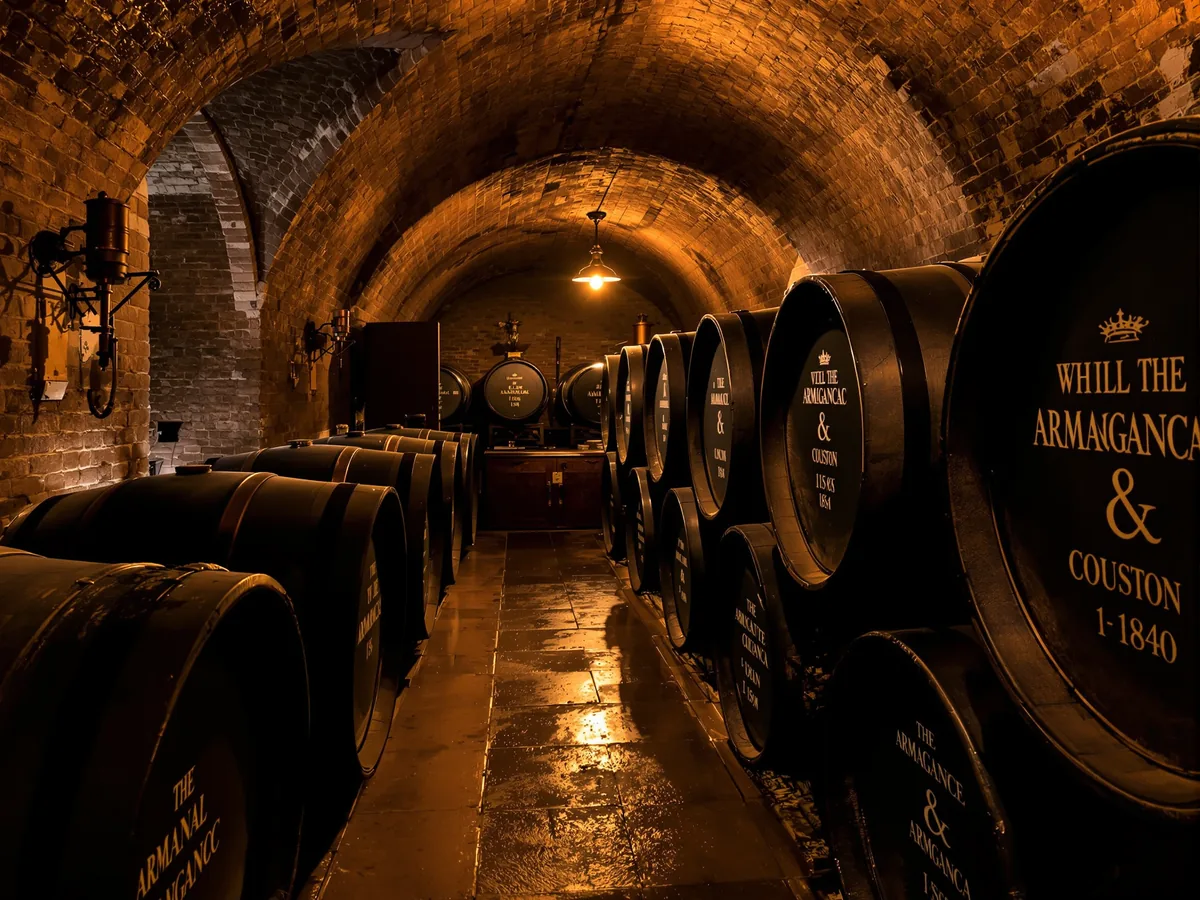
The distillate then goes into oak casks, where it gains colour, roundness and aromas while the alcohol slowly evaporates. Houses that keep very old vintages sometimes transfer them to glass demijohns to fix them in time. For one rule never changes: armagnac only ages in wood. In the bottle, it stays just as it was drawn from the cask. For a 1918 armagnac bottled recently, the time spent in wood is therefore counted in decades.
Aromas of a century-old armagnac
Neither the Sigognac 1918 nor the Jean Cavé 1918 comes with a published tasting note, and we do not invent one. What we can say is what the houses describe for their old vintages. At Sigognac, at Château de Bordeneuve, a round style that develops with age towards toasted dried fruit, roasted coffee and dark chocolate. In the Jean Cavé cellar, a mahogany colour and woody, vanilla and cocoa notes. An old armagnac of this age often also offers prune, sweet spices and rancio, with a very long finish.
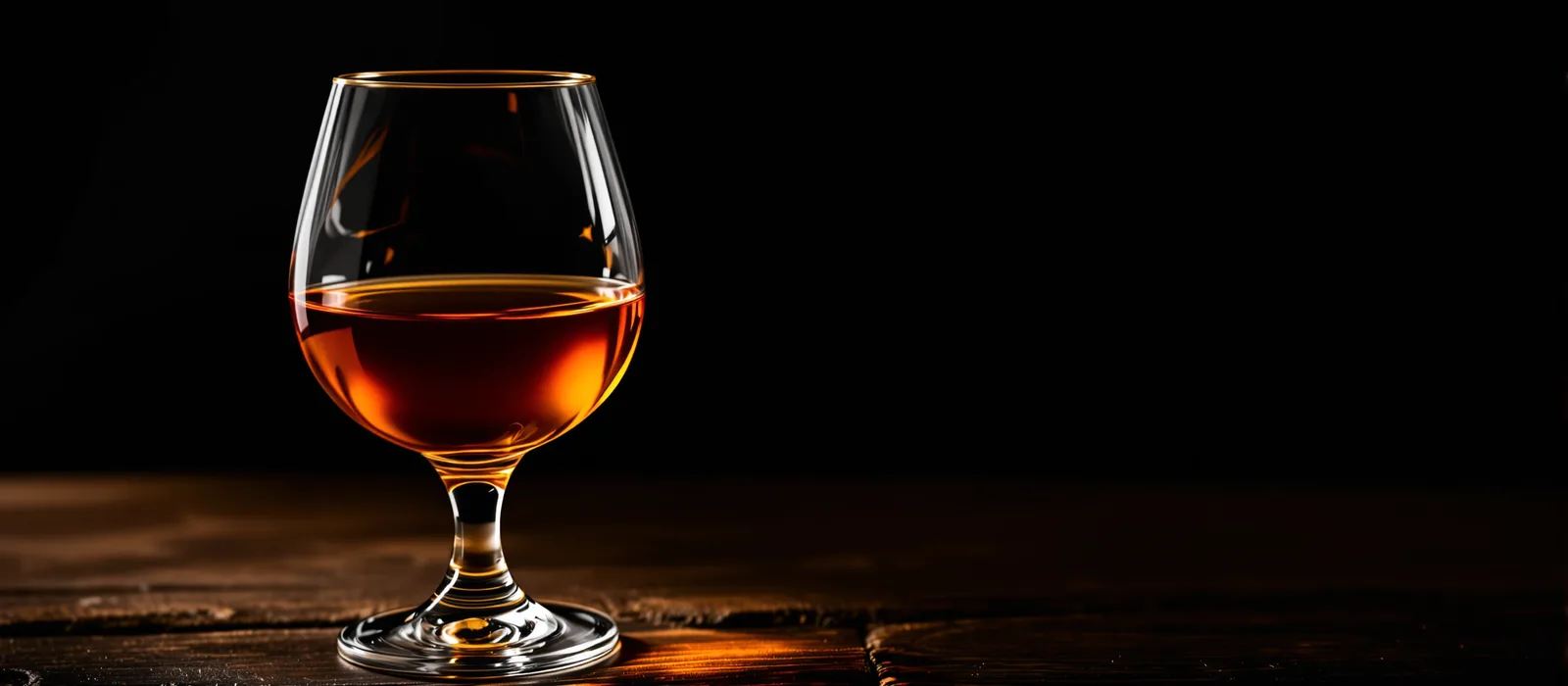
For tasting, serve a small measure in a tulip glass, at room temperature. Let the armagnac wake up for about ten minutes, warm the glass in your hand, then taste in very small sips. A moment like this is best experienced quietly, among connoisseurs.
Why give a 1918 armagnac
A 1918 armagnac is no longer a birth year gift: it is a piece of history. It is given for an extraordinary anniversary, such as the hundredth year of a family firm or a company, for the arrival of a major piece in a cellar, for a collector with a passion for the First World War, or to hand down to the next generation a bottle that has already lived through a century. The wooden case accompanies the gesture. And for the birthday of a history enthusiast, it is hard to find anything more fitting.
To keep it, store the bottle upright, in a dark, cool and stable place, so that the alcohol does not touch the cork. Unopened, it can wait for many years. Once opened, it keeps for several months.
Want to go even further back in time? Our 1900 armagnac brings together the same houses. For a slightly younger vintage, see our 1936 armagnac.
Frequently asked questions about 1918 armagnac
How much does a 1918 armagnac cost?
It depends on the house, the rarity of the lot and the bottling method, brut de fût or not. The price of each reference is shown on its product page, with its bottle size and strength.
How can I buy 1918 armagnac?
At Plaisirs de Gascogne, an online wine and spirits shop specialising in vintage armagnac: add the bottle to your basket, pay by secure card payment, and shipping is available in France and across Europe, in protective packaging for a breakage-free delivery. Our customer service will answer your questions before you order.
What are the characteristics of the 1918 armagnac?
Two Bas-Armagnacs from a single harvest, in 70 cl with a wooden case: Baron de Sigognac at 40% ABV, from ugni blanc and baco, and Jean Cavé brut de fût, unblended.
Where can I find 1918 armagnac?
It is rare, because few houses have kept this year. In our shop, you will find it from Baron de Sigognac and Jean Cavé. The other houses in our cellar, such as Château de Laubade, Armagnac Delord, Dartigalongue or Domaine de Pellehaut, offer more recent vintages, up to the 2000s.
What are the reviews of the 1918 armagnac?
Neither house publishes a note for this vintage, so we do not quote any reviews. Our view as wine merchants concerns its rarity, which makes it a collector's bottle.
Why is the 1918 armagnac special?
Because it comes from the year of the Armistice and was kept by Gascon families for more than a century before being bottled.
Also discover all our vintage armagnacs, year by year.
Please enjoy responsibly. Excessive alcohol consumption is harmful to health.



 Jean Cavé
113 bottles
 Armagnac Delord
92 bottles
 Baron de Sigognac
90 bottles
 Château de Millet
83 bottles
 Sempé
82 bottles
 Dartigalongue
77 bottles
 Marcel Trépout
72 bottles
 Clés des Ducs
67 bottles
 Château de Monluc
64 bottles
 Armagnac Castarède
63 bottles
 Château de Laubade
42 bottles
 Château de Bordeneuve
32 bottles