What a 1921 vintage promises
A vintage armagnac keeps a simple promise: everything in the bottle comes from a single harvest, that of the year on the label. VSOPs, XOs and hors d'âge, by contrast, are blends of several years, composed to keep a consistent style. With a 1921 vintage, you taste instead one precise season, as the cask has transformed it.
A hundred and five years later, bottles like this are found only with the families who kept their reserves rather than selling them. They are few in number, and each carries a share of the memory of its cellar.
1921, the year of a perfume that became famous
It was in 1921 that Coco Chanel launched her perfume N°5, composed by the perfumer Ernest Beaux (source: Wikipedia, article "Chanel N°5"). The same year, Albert Einstein received the Nobel Prize in Physics for 1921, for his work on the photoelectric effect (source: Wikipedia, article "Albert Einstein"). Far from Paris, Gascon winegrowers harvested as they did every autumn, and part of that wine, distilled the following winter, would become the two bottles presented here. On the harvest itself, we have no producer source, so we attribute no particular quality to it.
Our two 1921 armagnacs
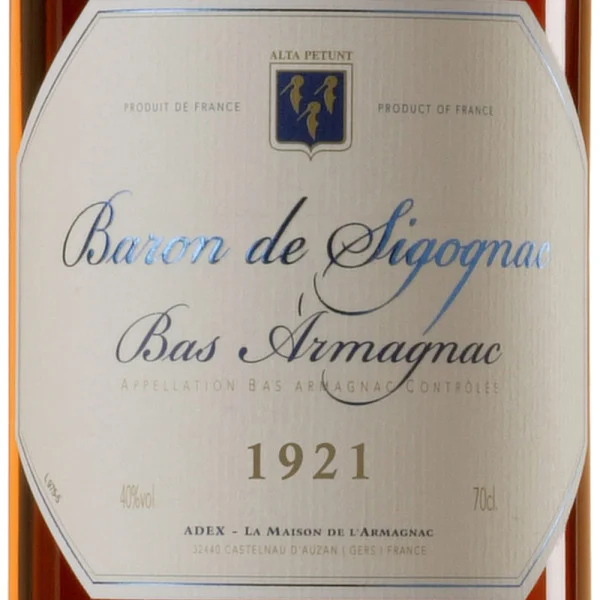
- Baron de Sigognac: a 1921 at 40% ABV, from ugni blanc and baco, kept at Château de Bordeneuve, in Castelnau d'Auzan, where each year ages in its own cask. According to the house, its vintages are prepared to order, and the bottling date is shown on the back of the bottle. No tasting note is published for 1921;
- Jean Cavé: a 1921 Bas-Armagnac AOP drawn from the house's collection of old vintages, without any blending, and bottled brut de fût, with no added water. The exact strength is written on the label. The bottle comes in a wooden box.
The first, reduced to 40% ABV, is the more approachable. The second keeps the strength of its cask: it joins our brut de fût armagnacs, for those who love brandy in its original state.
Lannepax and Castelnau d'Auzan, two Gascon addresses
The house of Jean Cavé was born in Lannepax, in the Gers, in 1883: a winegrower became a distiller and cellar master there, and four generations later, Henri Cavé watches over one of the richest collections of old vintages in the appellation. Its oldest brandies rest in demijohns, in the paradis of the cellar.
Château de Bordeneuve, which ages the Baron de Sigognac armagnacs, has belonged to the Guasch family since 1974. The estate keeps harvests dating back to 1893 and produces little, some fifty casks a year according to the house. Its style is renowned as round and fruity, with notes of toasted dried fruit, coffee and dark chocolate that grow more pronounced with age.
These two estates are not the only ones to keep old distilled wines: in our shop, Château de Laubade, Dartigalongue, Delord, Castarède and Domaine de Pellehaut also offer vintages, for more recent years.
From the Gascon vine to the oak cask
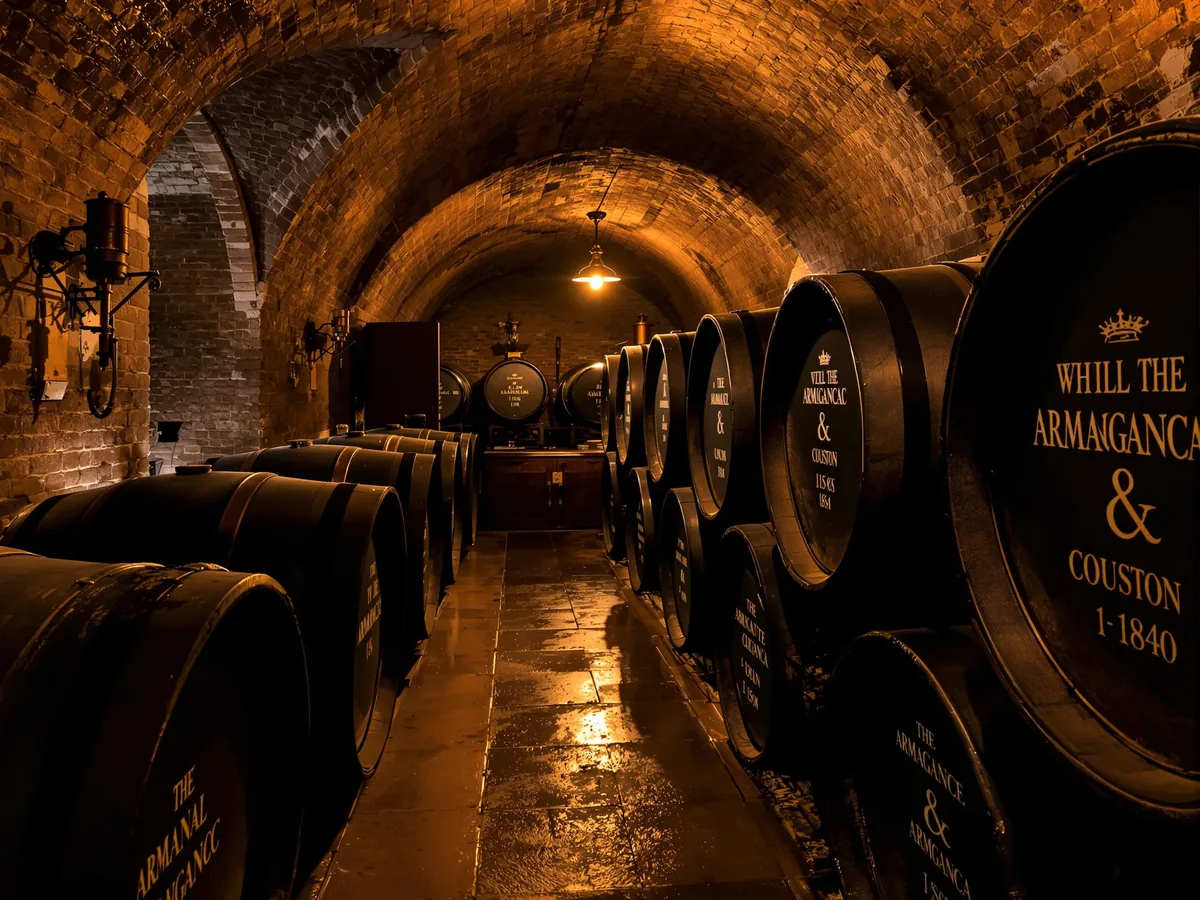
The starting point is a dry white wine of the appellation, made from ugni blanc, baco, folle blanche or colombard. It is distilled just once, continuously, in the armagnac still, during the winter that follows the harvest. The colourless distillate then goes into oak casks: there it gains its colour, its aromas and its roundness, while the alcohol gently falls through evaporation. Ageing stops at bottling; a 1921 bottled recently has therefore spent most of its century in wood or in demijohn.
This long ageing explains the rarity of old years: every winter, part of the volume evaporates, and a cask forgotten for a century gives back only a fraction of what it once held. Our two bottles come from Bas-Armagnac, the best known of the appellation's three terroirs, along with Ténarèze and Haut-Armagnac.
Tasting a 105-year-old armagnac
Choose a tulip glass, pour a little, and let the armagnac open up for at least ten minutes at room temperature. In very old brandies, you often find prune, walnut, leather, cocoa or spices, and sometimes rancio; but each bottle follows its own story. Taste the two 1921s side by side if you have the chance: the difference between a reduced armagnac and a brut de fût is a fine tasting lesson.
Giving a 1921 armagnac
In 2026, a 1921 can mark the 105th birthday of someone born that year, or the centenary of a house, a club or a family business founded around the same time. It also makes a memorable gift for a collector completing a vertical of old years, between our 1920 armagnac and our 1922 armagnac.
Keep the bottle upright, somewhere cool and away from light. Unopened, it has nothing to fear from the years; opened, it will keep for several months.
Your questions about 1921 armagnac
How much does a 1921 armagnac cost?
The price varies with the house and the bottling, reduced or brut de fût. It is shown on each product page, along with the bottle size and strength.
Where can I buy a 1921 armagnac?
In our Plaisirs de Gascogne shop, an online merchant specialising in vintage spirits: add the bottle to your basket, complete your purchase with secure payment, with careful shipping in France and across Europe in a protective parcel, and a customer service team available to advise you.
Which houses produce the 1921 armagnac?
In our selection, Baron de Sigognac and Jean Cavé, two Bas-Armagnac producers who age their distilled wine on their own estate.
What is the history of the 1921 armagnac?
That of a wine harvested in 1921, distilled the following winter and kept for more than a century, in cask then in bottle, by Gascon families.
What do reviews say about the 1921 armagnac?
Neither Baron de Sigognac nor Jean Cavé publishes a note for this vintage, so we quote no reviews. Our own view as merchants comes down to one word: rarity.
Should I drink it or keep it?
Both make sense: it will no longer age in the bottle, but nor will it deteriorate if it is well stored.
See all our vintage armagnacs, year by year.
Please enjoy responsibly. Excessive alcohol consumption is harmful to health.



 Jean Cavé
113 bottles
Jean Cavé
113 bottles
 Armagnac Delord
92 bottles
Armagnac Delord
92 bottles
 Château de Millet
79 bottles
Château de Millet
79 bottles
 Dartigalongue
76 bottles
Dartigalongue
76 bottles
 Baron de Sigognac
69 bottles
Baron de Sigognac
69 bottles
 Armagnac Castarède
63 bottles
Armagnac Castarède
63 bottles
 Clés des Ducs
48 bottles
Clés des Ducs
48 bottles
 Château de Laubade
43 bottles
Château de Laubade
43 bottles
 Domaine de Pellehaut
28 bottles
Domaine de Pellehaut
28 bottles
 Château de Bordeneuve
17 bottles
Château de Bordeneuve
17 bottles
 Charles de Granville
13 bottles
Charles de Granville
13 bottles
 Roger Groult
7 bottles
Roger Groult
7 bottles