2003, the year of the heatwave
For many French people, 2003 remains the summer when the heat never let up. In early August, a heatwave of exceptional scale struck Europe and France, with serious consequences for public health (source: Wikipedia, article "Canicule européenne de 2003"). The same year, Air France flew Concorde for the last time in commercial service, on 31 May 2003 (source: Wikipedia, article "Concorde").
What does this mean for the Gascon vines? None of the producers in our selection publishes an assessment of the 2003 harvest, so we refrain from stating anything about its quality. What we do know, on the other hand, is what each house says about its brandy today.
Nine 2003 armagnacs, six houses
The same year, but different terroirs, grape varieties and ageing choices: here is what each armagnac house publishes about its 2003, with its own tasting notes when it gives them.
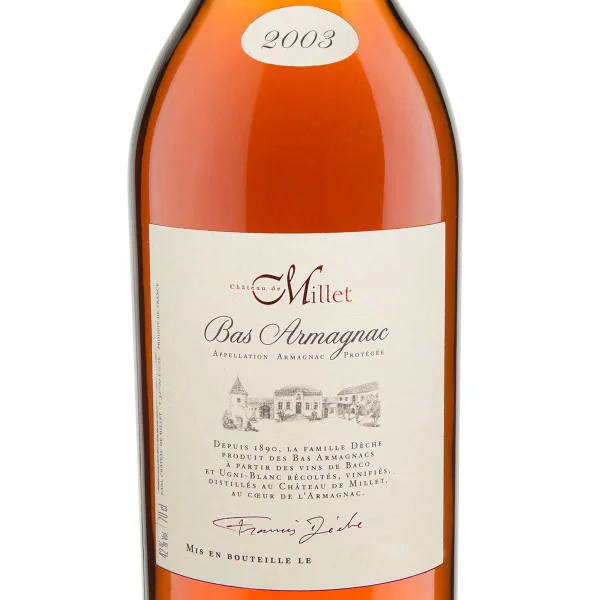
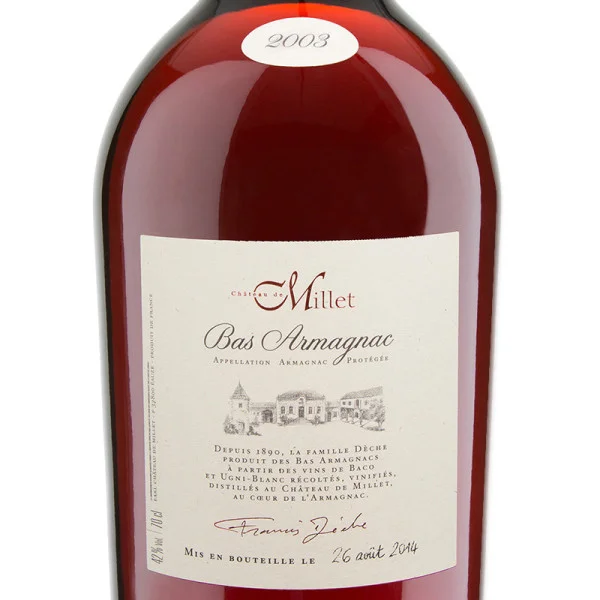
Château de Millet: an award-winning 2003
Grower-producers in Eauze for five generations, the Dèche family distils wines made from baco and ugni blanc on the estate. Its Château de Millet 2003, at 42% ABV, comes in 70 cl, in a 150 cl magnum and in a 250 cl Gascon pot. The house's 2026 catalogue describes a very fine first aroma of sweet spices and vanilla, a fruity, fresh and well-balanced palate, and a finish where these spices return. This 2003 won a gold medal at the Concours Général Agricole de Paris 2025 and a gold medal at the Spirits Selection in Brussels 2024. The vineyard is certified HVE 3.
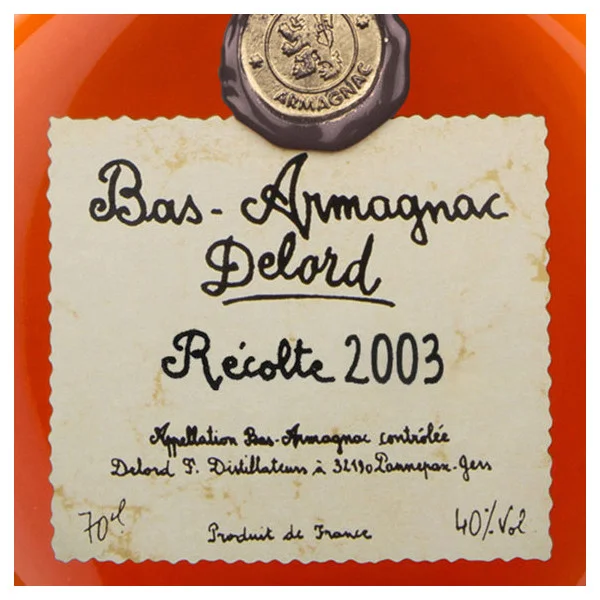
Delord: cooked fruit and rancio
Founded in Lannepax in 1893, the Armagnac Delord house ages its 2003 in Gascon oak casks and offers it at 40% ABV. It describes aromas of cooked fruit, cinnamon and light caramel, a rich and velvety palate of plum jam, toffee and sweet spices, then a soft finish with a discreet note of rancio.
Dartigalongue: two faces of the same vintage
In Nogaro since 1838, Dartigalongue offers two 2003s. The classic version, at 42% ABV, opens according to the house on peach, cooked plum, orange zest and toasted oak; the palate, round and long, stays on fruit, with a finish of cooked plum and spices.
The Single Cask 2003 comes from a single cask, no. 419, bottled at 46% ABV in a limited series of 524 numbered bottles. The house finds honey, vanilla, coconut and yellow fruit, a frank, spicy and fruity attack, and notes of exotic fruit on the finish: a fresh and indulgent armagnac, with pastry-like accents.
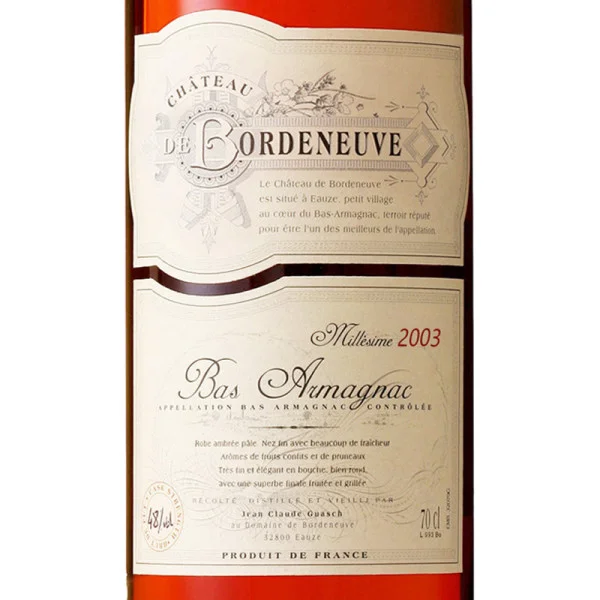
Château de Bordeneuve: an exotic brut de fût
In Castelnau d'Auzan, the Guasch family ages each year separately. The Château de Bordeneuve 2003, from ugni blanc and baco, is bottled brut de fût at 49% ABV. Its colour is orange-yellow with golden highlights; the first nose mixes pear, lychee and mango, then ginger and a peppery touch; the long finish moves towards prune and toasted hazelnut.
Clés des Ducs: a single harvest
A house founded in 1774 in Panjas, Clés des Ducs offers a 2003 at 40% ABV, never blended with other years. Its cellar master seeks a long and smooth brandy, with discreet oak.
Jean Cavé: the strength of the cask
A distiller and ageing house in Lannepax since 1883, Jean Cavé bottles its Bas-Armagnac 2003 at its natural strength, 52.5% ABV, without adding water.
Single cask, brut de fût, reduced: finding your way
A so-called reduced armagnac has been brought down to 40 or 42% by adding water: this is the case for Millet, Delord, the classic Dartigalongue and the bottle from Panjas. A brut de fût keeps the strength of the cask, here 49% for Bordeneuve and 52.5% for Jean Cavé; find them alongside our other brut de fût armagnacs. Finally, the single cask comes from a single barrel: no other is mixed in, and the number of bottles is necessarily limited. For the Dartigalongue no. 419, the cellar master chose 46%, the strength which, according to the house, best reveals the year.
How a 2003 armagnac is born
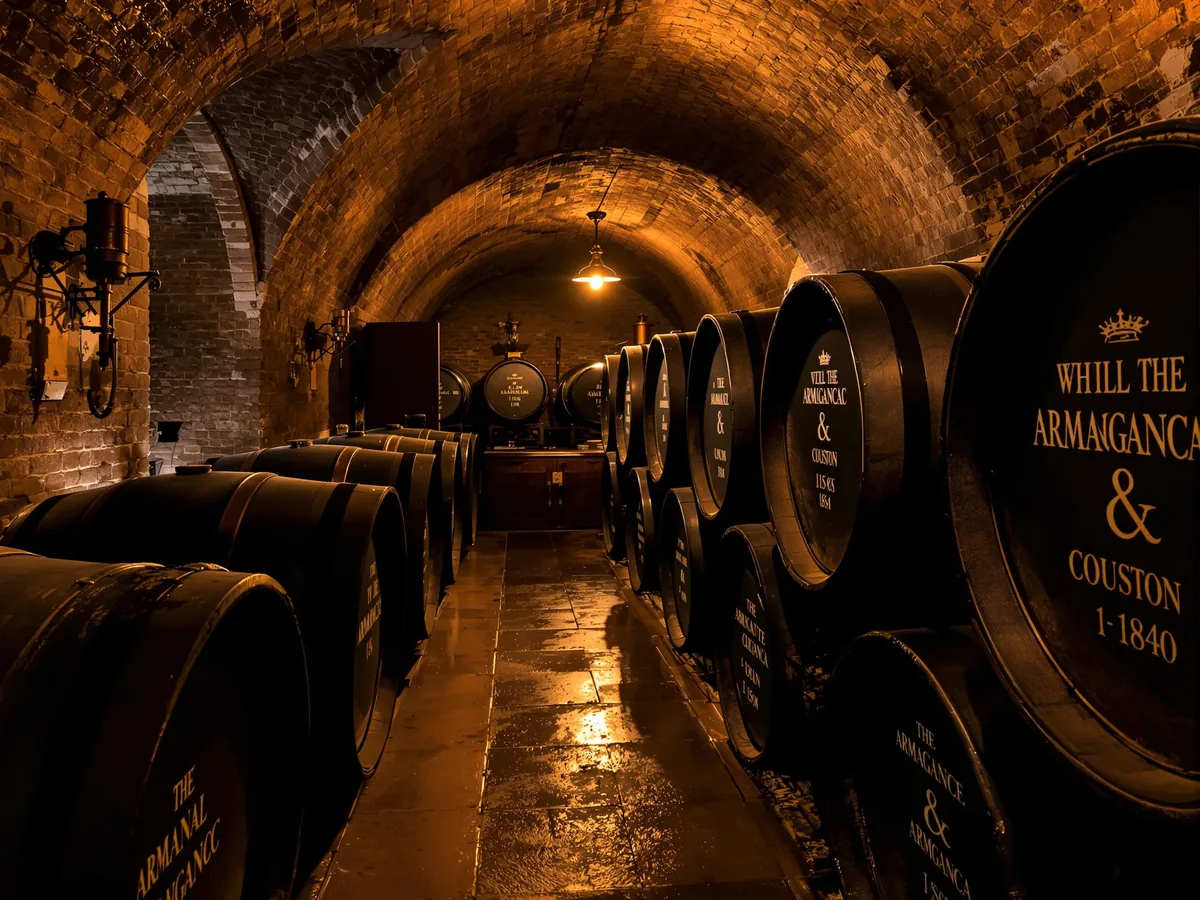
Vintage means dated: the label shows the year of the harvest, and the brandy contains only that harvest. No blending of ages, as in a VSOP or an XO: each 2003 is the unique expression of one year and one estate. It is a demanding tradition, and one of the finest of this Gascon spirit.
Everything starts with the grapes. The white wine, made from ugni blanc, baco blanc, folle blanche or colombard, comes from the vines of the region, where each terroir marks the character of the brandy. Distillation takes place the following winter, in the armagnac still, continuously and in a single pass. Then ageing begins in oak casks, in the cellar: the wood gives the armagnac its colour and its woody structure, while part of the alcohol evaporates. Baco is known for the roundness it brings on the sands of Bas-Armagnac; folle blanche, a historic grape variety, for its finesse.
Armagnac is thus one of the oldest brandies in France, and its history can be read in every cellar in the Gers.
Tasting a 23 year old armagnac
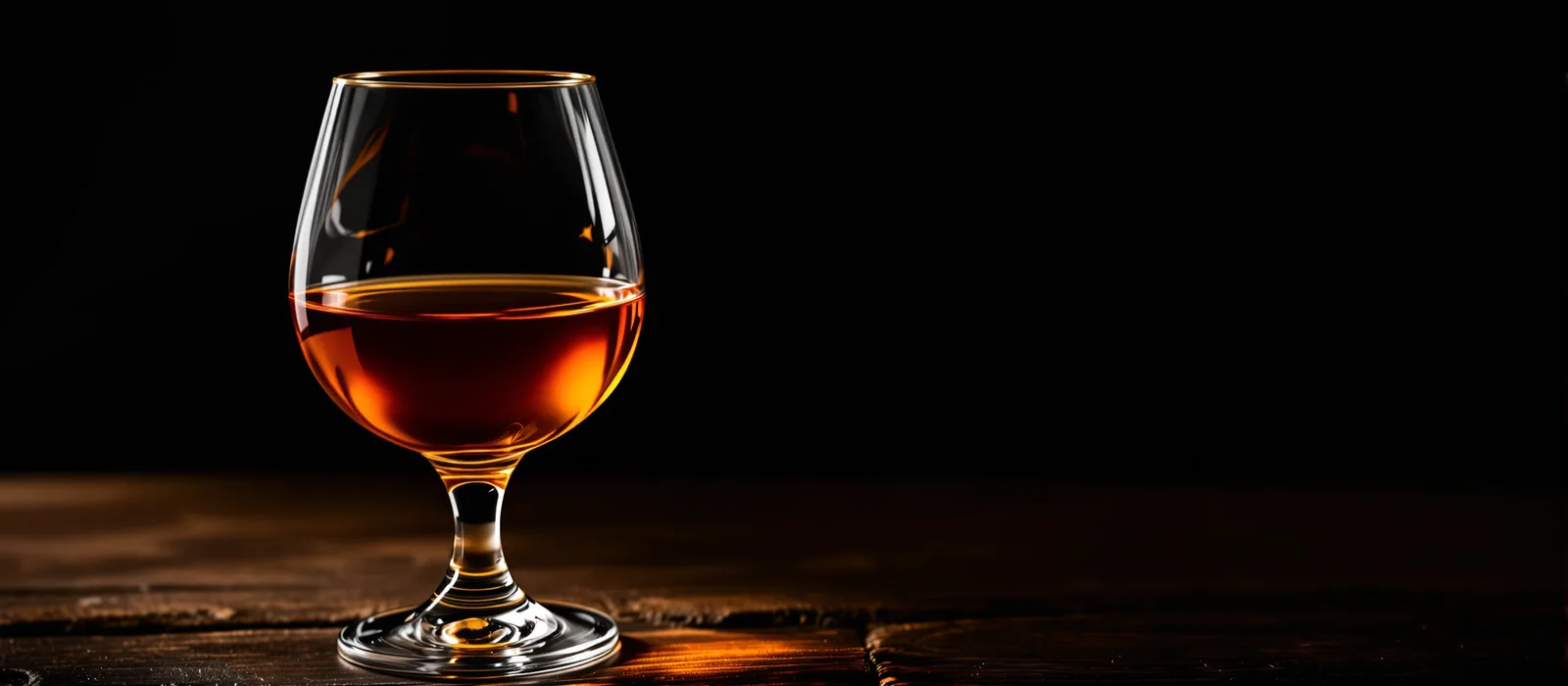
The houses' tasting notes trace a common thread for this year: yellow fruit, plum and prune, caramel, with more exotic touches at Bordeneuve and Dartigalongue. A complex profile, between the freshness of fruit and the roundness of age. Serve your 2003 armagnac at room temperature, in a tulip glass. Let it breathe for a few minutes, nose it, then taste in small sips. A brut de fût can take a drop of water. As pairings, think of dark chocolate, desserts with dried fruit, or simply the end of a good meal.
Store the bottle upright, away from light and heat: unopened, it no longer changes; once opened, it keeps for several months.
Giving a 2003 armagnac
Children born in 2003 turn 23 in 2026; couples married that year celebrate 23 years together. For them, a bottle of 2003 recalls a summer that no one has forgotten. The numbered single cask makes a collector's gift; the Gascon pot or the Millet magnum brings a whole table together.
Frequently asked questions about 2003 armagnac
Did the 2003 heatwave produce a great vintage?
The houses in our selection do not publish an assessment of the 2003 harvest, and we prefer not to invent one. The gold medals won by Château de Millet 2003 in 2024 and 2025 do, however, provide a concrete reference point.
Which 2003 armagnac should I choose?
For softness, a 2003 at 40 or 42%: Delord, Millet or Dartigalongue. For intensity, the Bordeneuve or the Jean Cavé brut de fût. For rarity, the single cask no. 419.
How much does a 2003 armagnac cost?
The price varies according to the house, the strength and the size, from 70 cl to the 250 cl Gascon pot, and according to rarity: a numbered single cask is not a classic vintage. Each product page shows the price.
Where can I buy a 2003 armagnac?
At Plaisirs de Gascogne, an online shop dedicated to vintage armagnacs from the South West: your order is prepared from bottles selected from the Gascon houses, with secure payment.
To compare with neighbouring years: 2002 armagnac, 2004 armagnac, or all our vintage armagnacs.
Please enjoy responsibly. Excessive alcohol consumption is harmful to health.



 Jean Cavé
113 bottles
Jean Cavé
113 bottles
 Armagnac Delord
92 bottles
Armagnac Delord
92 bottles
 Château de Millet
79 bottles
Château de Millet
79 bottles
 Dartigalongue
76 bottles
Dartigalongue
76 bottles
 Baron de Sigognac
69 bottles
Baron de Sigognac
69 bottles
 Armagnac Castarède
63 bottles
Armagnac Castarède
63 bottles
 Clés des Ducs
48 bottles
Clés des Ducs
48 bottles
 Château de Laubade
43 bottles
Château de Laubade
43 bottles
 Domaine de Pellehaut
28 bottles
Domaine de Pellehaut
28 bottles
 Château de Bordeneuve
17 bottles
Château de Bordeneuve
17 bottles
 Charles de Granville
13 bottles
Charles de Granville
13 bottles
 Domaine de Danis
7 bottles
Domaine de Danis
7 bottles