What "1905" means on a bottle of armagnac
The year written on a vintage armagnac refers to the harvest it comes from, and only one. Our 1905 armagnac therefore comes solely from the 1905 harvest, distilled then aged without ever meeting any other year. VSOP, XO and hors d'âge, in armagnac as in cognac, seek on the contrary a consistent style rather than the trace of a season. This is what is called a vintage. It is rare for such an old lot to have come down to us.
1905, the year of secularism and relativity
On 9 December 1905, the law on the separation of the Churches and the State was promulgated in France (source: Wikipedia, article "Loi de séparation des Églises et de l'État"). The same year, Albert Einstein published the papers that founded special relativity, hence the name "miracle year" given to 1905 (source: Wikipedia, article "Annus mirabilis papers"). On the Gascon harvest of 1905, however, we found no producer source, so we do not characterise it.
Our 1905 Bas-Armagnac
The bottle is signed Jean Cavé. Its product sheet presents it as a Bas-Armagnac AOP dated 1905, drawn from the house's reserves, unmixed with any other year. The 70 cl bottle comes with a wooden box. Unlike most of the neighbouring years in our cellar, its name does not bear the words brut de fût: we therefore do not claim it, and invite you to read the exact strength on the label.
If you are looking precisely for an armagnac left at its natural strength, our selection of brut de fût armagnacs brings several together.
The Jean Cavé house
In Lannepax, in the Gers, Jean Cavé settled in 1883 as a winegrower, distiller and cellar master, with his wife and two sons. Four generations later, Henri Cavé carries on the continuous armagnac distillation. The family has gathered one of the finest collections of old armagnacs in the appellation, including demijohns dating from 1900 kept in its "paradis". In 1905, the house was twenty-two years old.
How an armagnac comes through a century
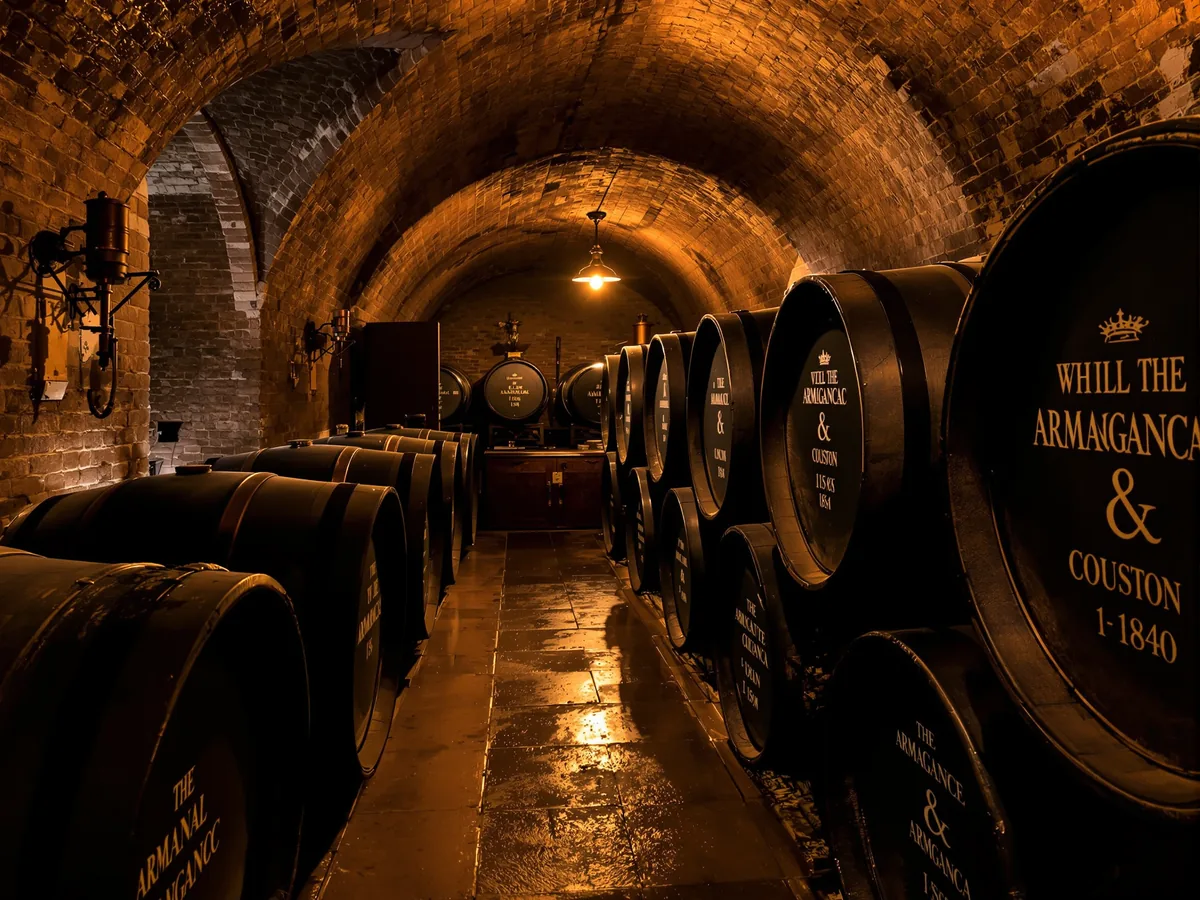
Armagnac is born in Gascony, in a production area shared between three regions: Bas-Armagnac, Ténarèze and Haut-Armagnac. The grape varieties are ugni blanc, baco, folle blanche and colombard. According to Wikipedia (article "Armagnac (eau-de-vie)"), before phylloxera the vineyard was planted mainly with folle blanche, also called piquepoult. Folle blanche is therefore the historic grape variety of armagnac production, that of the very old years; we do not know, however, exactly which grape varieties make up this 1905, and the product sheet does not say. After vinification, the white wine is distilled only once, continuously, in the armagnac still: this is the distillation specific to the region. The distillate then ages in oak casks: it takes on colour, softens and gains aromas, while the alcohol slowly falls. To stop this evolution, the houses that keep old lots transfer them into demijohns, before bottling, the date of which is not given on the product sheet.
Once bottled, armagnac no longer ages, and it keeps for a very long time if properly stored: upright, so that the alcohol does not eat into the cork, in a dark, cool place without sudden changes in temperature. After opening, it keeps for several months; the emptier the bottle, the better it is to finish it without waiting too long.
Tasting a 121 year old armagnac
No tasting note is published by the house for this 1905, and we do not attribute one to it. Armagnacs more than a century old, of great aromatic complexity, often show a mahogany colour, aromas of dried fruit, prune, wax and spices, a pronounced rancio and a lingering finish on the palate. Serve it as a digestif, at room temperature, in a tulip glass, in a small measure, and give it time to awaken. An armagnac like this is enjoyed neat, never in a cocktail.
Giving a 1905 armagnac
A 1905 armagnac lends itself to gifts that tell a story: the anniversary of a house or an association founded in 1905, a lover of science or history, a cellar of very old years, a handing down between generations. Its wooden box makes it a ready-to-give present.
Around this year, see the 1904 armagnac and the 1907 armagnac. For another very old year, the Baron de Sigognac from Château de Bordeneuve features in our 1900 armagnac. Our shop also offers more recent years from other houses: Château de Laubade, Castarède, Dartigalongue, Armagnac Delord, Château de Millet, Laballe or Domaine de Pellehaut. From Château de Laubade to Domaine de Pellehaut, each house has its own style, and Baron de Sigognac has its own.
Frequently asked questions about 1905 armagnac
How much does a 1905 armagnac cost?
The price reflects the rarity of a 121 year old lot. It is shown on the product page, with the bottle size and strength.
Where can I buy a 1905 armagnac?
On Plaisirs de Gascogne, an online shop for Gascon spirits: add the bottle to your basket, pay for your order securely by bank card, and it is shipped to France and Europe. A question? Our customer service team answers your questions before you buy.
How do shipping and delivery work?
The bottle is shipped in packaging suited to spirits, with its wooden box. Delivery is available in France and Europe; times and conditions are specified when you order.
What are the characteristics of the 1905 armagnac?
A Bas-Armagnac AOP from Jean Cavé, from a single harvest, in 70 cl with a wooden case.
What are the reviews of the 1905 armagnac?
The house does not publish a rating for this year, so we do not quote any reviews. Our view as wine merchants rests on its rarity.
What is the history of the 1905 armagnac?
That of a 1905 harvest, distilled in Bas-Armagnac and kept for more than a century by the Cavé family.
Discover all our vintage armagnacs, year by year.
Please enjoy responsibly. Excessive alcohol consumption is harmful to health.



 Jean Cavé
113 bottles
 Armagnac Delord
92 bottles
 Château de Millet
83 bottles
 Dartigalongue
76 bottles
 Baron de Sigognac
69 bottles
 Armagnac Castarède
63 bottles
 Clés des Ducs
48 bottles
 Château de Laubade
43 bottles
 Domaine de Pellehaut
28 bottles
 Château de Bordeneuve
17 bottles
 Charles de Granville
13 bottles
 Roger Groult
7 bottles