What is a 1928 vintage?
A vintage armagnac contains only one harvest: that of the year written on the label. No younger brandy to soften it, no older brandy to give it more backbone. That is the whole difference from a VSOP, an XO or a hors d'âge, which are blends of several harvests, composed to find the same taste from one bottle to the next. A 1928 vintage is therefore unique by definition: it reflects one year, one terroir and one cellar.
For this vintage to reach you, a family had to keep it for nearly a hundred years, without giving in to the temptation to sell it sooner or mix it with other lots. Every year, part of the volume evaporated through the cask. Little remains, and that little cannot be replaced. This is what sets an old vintage apart from other spirits made for keeping: time spent in the cellar cannot be made up.
1928, the year of penicillin
In September 1928, in London, the Scottish doctor Alexander Fleming noticed that a mould was preventing bacteria from growing in one of his culture dishes: this was the discovery of penicillin, the first antibiotic (source: Wikipedia, article "Alexander Fleming"). The same year, on 18 November, Walt Disney presented Steamboat Willie, the sound cartoon that made Mickey Mouse famous (source: Wikipedia, article "Steamboat Willie"). In Gascony, the autumn 1928 harvest yielded the wine that would be distilled the following winter.
Some retailer sources describe 1928 as a great year for armagnac. We found no producer source to confirm this, so we prefer not to characterise this harvest, and to keep to what the houses say about their own bottles.
Our two 1928 armagnacs
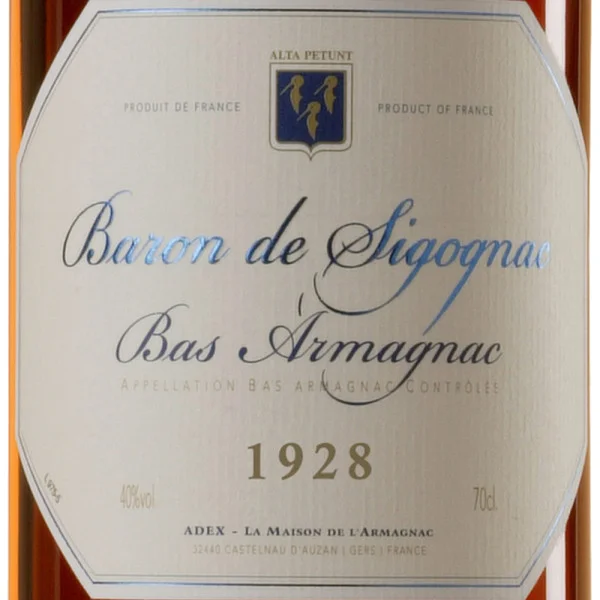
- Baron de Sigognac: a 1928 at 40% ABV, from ugni blanc and baco, aged at Château de Bordeneuve, in Castelnau d'Auzan. For this vintage, the house publishes a description: a deep amber colour, a superb nose of candied fruit, very rich in vanilla, a very round palate with great finesse, and a subtly woody finish, with vanilla and a slight sweetness. The bottle is prepared to order, and the bottling date appears on the back;
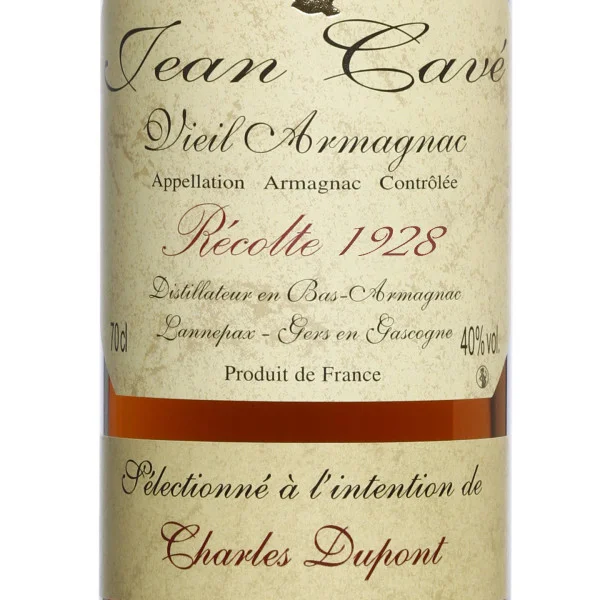
- Jean Cavé: a 1928 Bas-Armagnac AOP, drawn from the house's collection of old years, in Lannepax, without any blending. It is bottled brut de fût, with no added water; its exact alcohol content is written on the label, and we do not repeat it here as we have not verified it. The house does not publish a commentary for this vintage. The bottle comes in a wooden box.
Two styles for the same year: an armagnac reduced to 40% ABV, round and indulgent according to its product page, and a brut de fût at natural strength. For other bottles in this second style, see our brut de fût armagnacs.
What the Sigognac 1928 product page says
The Baron de Sigognac commentary gives a good idea of what to expect from an armagnac nearly a century old. The deep amber colour reflects a very long stay in cask. The candied fruit and vanilla on the nose are aromas that oak and time develop little by little. Finally, the roundness on the palate comes from the slow evaporation of the alcohol and the gentle oxidation that takes place through the staves. The product page classes it among woody, floral, indulgent and round armagnacs.
For the Jean Cavé, the house says nothing more: a brut de fût generally keeps more power than a reduced armagnac, but only tasting will reveal how this 1928 expresses itself.
Lannepax and Bordeneuve, two keepers of old years
In 1883, Jean Cavé set up in Lannepax, in the Gers, as a winegrower, distiller and cellar master. The house, now run by Henri Cavé, of the fourth generation, has built up over time one of the most remarkable collections of old vintages in the appellation. In its paradis, glass demijohns keep century-old brandies. According to the house, its long-aged armagnacs take on a mahogany hue and woody, vanilla and cocoa notes.
Château de Bordeneuve lies in Castelnau-d'Auzan-Labarrère, in the heart of Bas-Armagnac. The Guasch family has owned it since 1974 and ages the Baron de Sigognac armagnacs there in small quantities: some fifty casks a year, according to the house. Each vintage ages separately, and the estate keeps years dating back as far as 1893. The house style is described as round, with long finishes.
For more recent years, other estates and châteaux of the South West await you in our shop: Château de Laubade, Château de Millet, Castarède, Delord, Dartigalongue, Clés des Ducs or Domaine de Pellehaut. Castarède, for example, offers vintages kept for a very long time in cask, and each house has its own page where you can discover its cellar and its history.
How armagnac passes through a century
In the beginning there is a dry white wine, made from the appellation's grape varieties: ugni blanc, baco, folle blanche and colombard. Folle blanche, a historic grape variety of Gascony, is renowned for its floral finesse; ugni blanc and baco, found in our Sigognac, are today the most widely planted. In the winter following the harvest, the wine goes just once through the armagnac still, in continuous distillation. Cognac, for its part, is distilled twice: this is one of the great differences between the two brandies.
The distillate then goes into cask. The oak gives it its colour, its tannins and part of its aromas, and the air passing through the staves rounds it out. Meanwhile, the alcohol slowly falls. When the house judges the armagnac ready, it bottles it or transfers it to a demijohn: it then stops evolving. The bottling date, when it is given, therefore tells you the real length of ageing.
The appellation comprises three terroirs: Bas-Armagnac, Ténarèze and Haut-Armagnac. Our two 1928s come from Bas-Armagnac, whose tawny sands are renowned for giving fine brandies.
Tasting a 1928 armagnac
A 98-year-old armagnac is tasted without haste. Pour a small measure into a tulip glass, at room temperature, and let it rest for ten minutes or so. Begin by looking at the colour, then smell without swirling: the aromas described by Sigognac reveal themselves better when given time. Then warm the glass in your hand and taste in small sips. The Jean Cavé brut de fût calls for even more delicacy; a few drops of water can help it open up.
At table, save it for the end of the meal, on its own or with a piece of dark chocolate. And once the last sip is gone, smell the empty glass again: an old armagnac leaves its imprint there for a long time.
Ordering your 1928 armagnac
Our online shop is devoted to vintage armagnacs and the spirits of Gascony. On each product page, you will find the house, the bottle size, the alcohol content and the price. Simply add the bottle to your basket, confirm the order from your customer account, then pay securely. Shipping is handled with care: old bottles travel wedged in protective packaging, in France and across Europe. Our terms of sale set out the lead times, and our contact page lets you ask any question before you buy. As with a great cognac or a rare whisky, a bottle of this age deserves careful delivery: that is our priority.
Giving a 1928 armagnac
Among gift ideas around spirits, an armagnac from the year of birth remains one of the most personal. In 2026, a 1928 celebrates the 98th birthday of someone born that year. It also honours the anniversary of a house, a business or an estate founded the same year, and will delight a collector of old vintages. For a doctor, a pharmacist or a researcher, the year of penicillin even adds one more nod. In a vertical, it takes its place between our 1927 armagnac and our 1929 armagnac.
Keep the bottle upright, away from light and heat, so that the alcohol does not touch the cork. Unopened, it will keep for many years; opened, for several months.
Frequently asked questions about 1928 armagnac
What is the price of a 1928 armagnac?
It depends on the house and the method of bottling. The price of each reference is shown on its product page, along with the bottle size and strength.
Where can I buy a 1928 armagnac?
At Plaisirs de Gascogne, an online merchant specialising in vintage armagnac: add to basket, secure payment, careful delivery in France and across Europe, and a customer service team ready to listen before you order.
How does the house describe the 1928 armagnac?
For the Baron de Sigognac, the house describes a deep amber colour, a very vanilla-rich nose of candied fruit, a very round and fine palate, and a woody finish with vanilla and a slight sweetness. Jean Cavé does not publish a commentary for its 1928.
Which producers offer a 1928 armagnac?
In our selection, Baron de Sigognac and Jean Cavé, two Bas-Armagnac houses.
Is 1928 a great year for armagnac?
We have no producer source to say so. We prefer to speak of what can be verified: the age, the house and, for the Sigognac, the commentary published by the house.
Should I drink it or keep it?
It is up to you: an armagnac no longer ages in the bottle, but it does not deteriorate if it stays sealed, upright and cool. There is no hurry to open it when the day comes.
Discover all our vintage armagnacs, year by year.
Please enjoy responsibly. Excessive alcohol consumption is harmful to health.



 Jean Cavé
95 bottles
Jean Cavé
95 bottles
 Armagnac Delord
92 bottles
Armagnac Delord
92 bottles
 Château de Millet
79 bottles
Château de Millet
79 bottles
 Dartigalongue
75 bottles
Dartigalongue
75 bottles
 Baron de Sigognac
69 bottles
Baron de Sigognac
69 bottles
 Armagnac Castarède
59 bottles
Armagnac Castarède
59 bottles
 Clés des Ducs
48 bottles
Clés des Ducs
48 bottles
 Château de Laubade
31 bottles
Château de Laubade
31 bottles
 Domaine de Pellehaut
17 bottles
Domaine de Pellehaut
17 bottles
 Château de Bordeneuve
17 bottles
Château de Bordeneuve
17 bottles
 Charles de Granville
13 bottles
Charles de Granville
13 bottles
 Domaine de Danis
7 bottles
Domaine de Danis
7 bottles