One bottle, one harvest
On this page, there is no long list of references: for 1953, our cellar holds just one bottle. That is the reality of old vintages. For a 1953 armagnac to still exist today, a producer had to set aside part of the harvest, let it age without selling or blending it, then hand it down from one generation to the next. Few houses did so, and the quantities that remain can be counted in a handful of bottles.
Here the word vintage takes on its full meaning. The label bears one year only, the year of the harvest, and the entire contents come from that crop. A VSOP, an XO or a hors d'âge follow a different logic: they are blends of several brandies, classified according to the age of the youngest. A vintage, on the other hand, fixes a date. That is what makes it the most fitting gift to celebrate a particular year.
1953, the year of a coronation
On 2 June 1953, Elizabeth II was crowned at Westminster Abbey, in London, more than a year after her accession to the throne (source: Wikipedia, article "Couronnement d'Élisabeth II"). The ceremony was followed throughout the Commonwealth and opened one of the longest reigns in history. The same year, in the Gers, the vines gave the harvest that would become, much later, the bottle on this page. We have no producer source on the quality of this Gascon harvest, so we prefer not to describe it.
Jean Cavé's 1953, drawn from the family collection
The house of Jean Cavé has been based in Lannepax, in the heart of Bas-Armagnac, since 1883. That year, Jean Cavé, a winegrower, settled there as a distiller and cellar master with his wife and two sons. Four generations later, Henri Cavé carries on the armagnac tradition of continuous distillation and looks after a collection of old vintages that is among the most remarkable in the appellation, including demijohns kept in the "paradis" of the cellar.
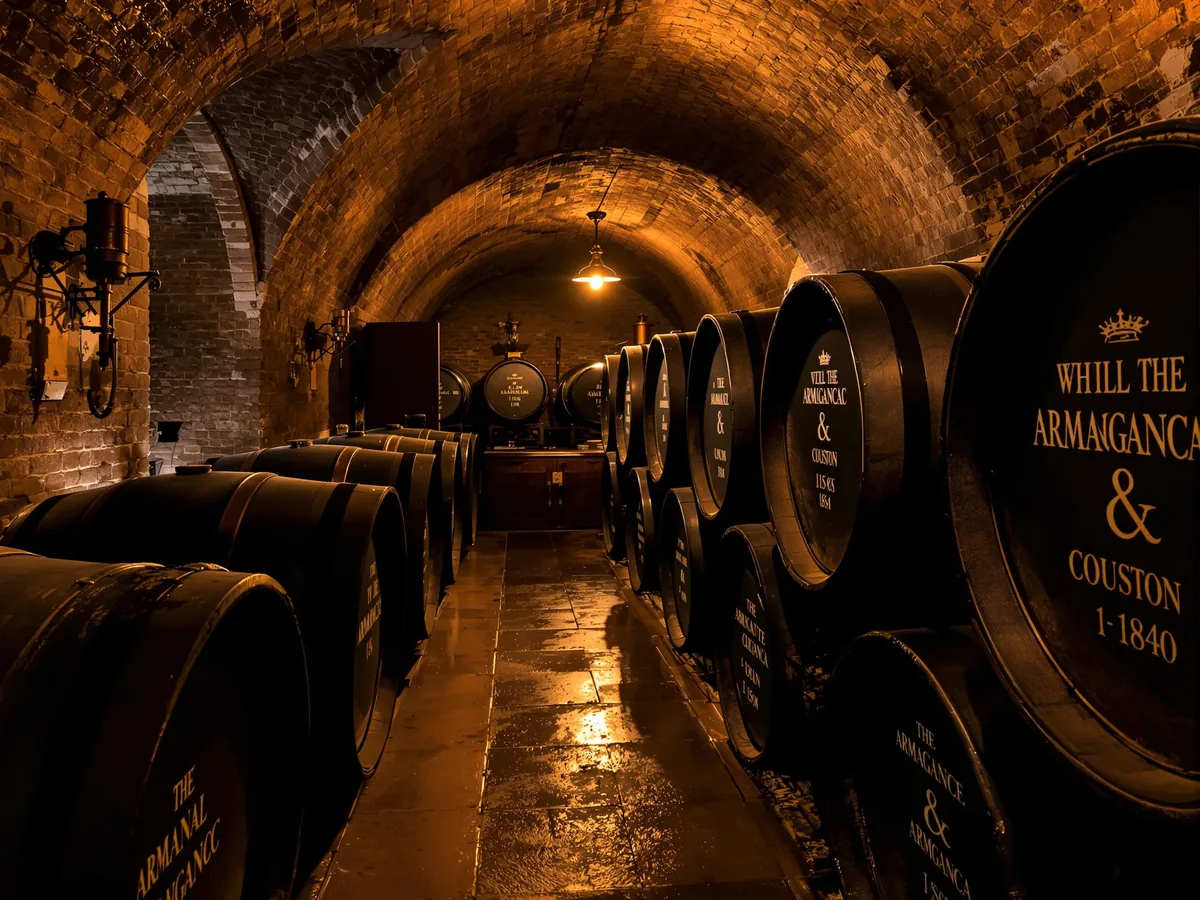
This 1953 Bas-Armagnac AOP comes from that collection. According to the house, its prestige vintages have never been blended: each one remains characteristic of a single year. The brandies are aged in Gascon oak casks in the family cellars. This 1953 is a brut de fût armagnac, bottled without reduction, in a 70 cl bottle, and it comes with a wooden case. Its natural strength is shown on the bottle's label.
From vine to cellar: how an armagnac is made
It all starts with a dry white wine. The armagnac appellation allows several grape varieties, including ugni blanc, baco blanc, folle blanche and colombard; the house does not specify the exact grape varieties of this vintage. This wine, low in alcohol and fairly lively, is distilled during the winter in the armagnac still, a copper apparatus that works continuously. The result is a clear brandy, still rustic, which has everything to gain from contact with wood.
Then comes the long ageing in oak casks. Year after year, the brandy takes on its colour, grows rounder and gains aromas of vanilla and spice, while part of the alcohol evaporates. A key point: this process stops as soon as the brandy is bottled. An armagnac does not improve in the glass; the bottling date, when it appears on the label, therefore tells you how long it really spent in wood.
Brut de fût: what it changes in the glass
Most armagnacs are reduced before bottling: water is added to bring them down to around 40 or 42% ABV. A brut de fût escapes this reduction. It keeps the strength it had when it left the cask, which makes it a more direct, more concentrated brandy, true to what you taste in the cellar. In a very old armagnac, this strength can in fact be modest: after decades in wood, the angels' share has done its work.
Tasting an old 1953 armagnac
Jean Cavé does not publish a tasting note specific to this vintage, and we do not invent one. The house does, however, describe the style of its long-aged brandies: a mahogany colour, with woody, vanilla and cocoa notes. In armagnacs of this age, you also often find prune, dried fruit and the taste of rancio that connoisseurs look for, with a long finish on the palate.
Serve it in a tulip glass, at room temperature, in a small measure. Let it rest for several minutes, then come back to it in small sips: an old armagnac changes a great deal as it breathes, and its aromatic profile unfolds slowly. A quiet moment suits it better than the end of a heavy meal.
Giving an armagnac from a birth year
In 2026, people born in 1953 celebrate their 73rd birthday. It is not a round number, and that is sometimes when a gift touches most: a bottle from their year, chosen for them, without waiting for an "official" birthday. The wooden case does the rest. For couples married in 1953, it is also a way to celebrate more than seventy years of life together.
If the bottle is being kept for later, store it upright, away from light and changes in temperature, so that the alcohol does not touch the cork. Unopened, it keeps for decades. Once opened, it lasts several months; the lower the level, the better it is to finish it.
Looking for a nearby year? Discover our 1956 armagnac, also from Jean Cavé.
Frequently asked questions about 1953 armagnac
How much does a 1953 armagnac cost?
It depends on the rarity of the lot, the house and the bottling method. The product page for our 1953 shows the bottle size and the price.
Where can I buy a 1953 vintage armagnac?
At Plaisirs de Gascogne, an online shop dedicated to vintage armagnacs. The bottle comes directly from the house of Jean Cavé; ordering and payment are secure, and delivery is handled with care, in France and across Europe.
What are the characteristics of this 1953 armagnac?
A Bas-Armagnac AOP from a single harvest, unblended, brut de fût, in 70 cl, presented in a wooden case.
Who are the producers of 1953 armagnac?
With us, just one: Jean Cavé, in Lannepax. Other houses such as Château de Laubade or Dartigalongue offer more recent vintages in our selection.
How should I taste a 1953 armagnac?
Neat, without ice, in a tulip glass, after letting it breathe for a few minutes.
Discover all our vintage armagnacs, year by year.
Please enjoy responsibly. Excessive alcohol consumption is harmful to health.



 Jean Cavé
113 bottles
Jean Cavé
113 bottles
 Armagnac Delord
92 bottles
Armagnac Delord
92 bottles
 Château de Millet
79 bottles
Château de Millet
79 bottles
 Dartigalongue
76 bottles
Dartigalongue
76 bottles
 Baron de Sigognac
69 bottles
Baron de Sigognac
69 bottles
 Armagnac Castarède
63 bottles
Armagnac Castarède
63 bottles
 Clés des Ducs
48 bottles
Clés des Ducs
48 bottles
 Château de Laubade
43 bottles
Château de Laubade
43 bottles
 Domaine de Pellehaut
28 bottles
Domaine de Pellehaut
28 bottles
 Château de Bordeneuve
17 bottles
Château de Bordeneuve
17 bottles
 Charles de Granville
13 bottles
Charles de Granville
13 bottles
 Roger Groult
7 bottles
Roger Groult
7 bottles