A young AOC born in 2005
According to the Bureau National Interprofessionnel de l'Armagnac, the Blanche Armagnac AOC was born in 2005 at the producers' initiative. They were used to keeping part of the freshly distilled eau-de-vie for their own needs, particularly in cooking. The Armagnac appellation decree of 26 December 2014 took over the production conditions laid down by the original text: blanche can only be produced within the armagnac area, from identified vineyards.
It is therefore an eau-de-vie from the same terroir and the same know-how as amber armagnac, with one major difference: it is not aged in cask. It is a white spirit, focused on fruit and freshness, whereas classic armagnac gains its colour, its vanilla and its woody notes over time.
How Blanche d'Armagnac is made
- Grape varieties: folle blanche, ugni blanc, baco and colombard, used alone or blended;
- Winemaking: it favours fruitiness, with wines rich in fine lees that release their aromas in the still;
- Distillation: early, to preserve the qualities of the wine, with a selection of the finest runs and higher distillation strengths than for traditional armagnac;
- Maturation: as soon as it leaves the still, the eau-de-vie is kept in an inert container to preserve its crystal-clear appearance. For at least 3 months, often much longer, the producer aerates it and gradually lowers its strength by adding water, to reveal its roundness;
- Control: uniquely among AOC eaux-de-vie, each batch is sampled, analysed and tasted by a panel before being authorised for sale.
Our Blanches d'Armagnac, estate by estate
Castarède and Delord
Castarède's blanche blends folle blanche, ugni blanc and colombard. The nose evokes white flowers, fresh plum and toffee; the palate, soft and smooth, keeps a hint of bitterness that gives it length. It is bottled at 40 % ABV. At Delord, Sylvain Delord chose colombard, a variety known for its fruitiness, with methodical winemaking: settling, temperature-controlled fermentation, racking. It is bottled at 42 % ABV.
Dartigalongue and Clés des Ducs
Dartigalongue's Un-Oaked has never seen a cask: it matures in stainless steel tanks and its strength is lowered step by step to 43 %. A subtle nose of pear, apple and white flowers, a broad and smooth palate, a finish of sweet almond. The blanche from Clés des Ducs, distilled in Gondrin in a single distillation, surprises with its floral and white pepper notes; round and never dry, it makes a fine cocktail base.
Jean Cavé and Château de Bordeneuve
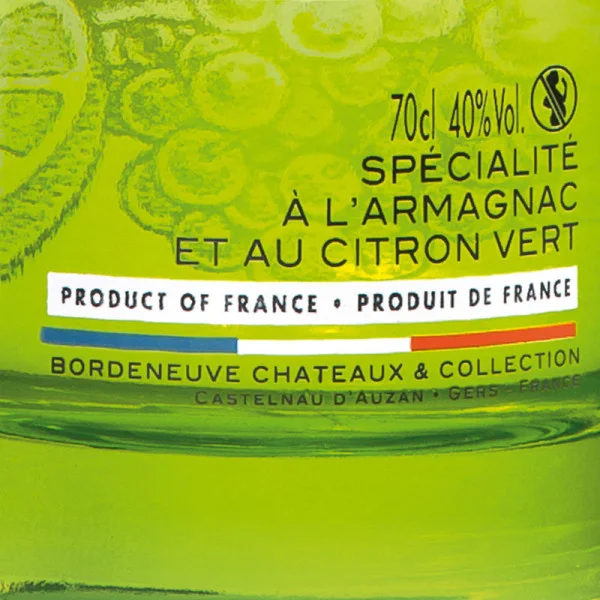
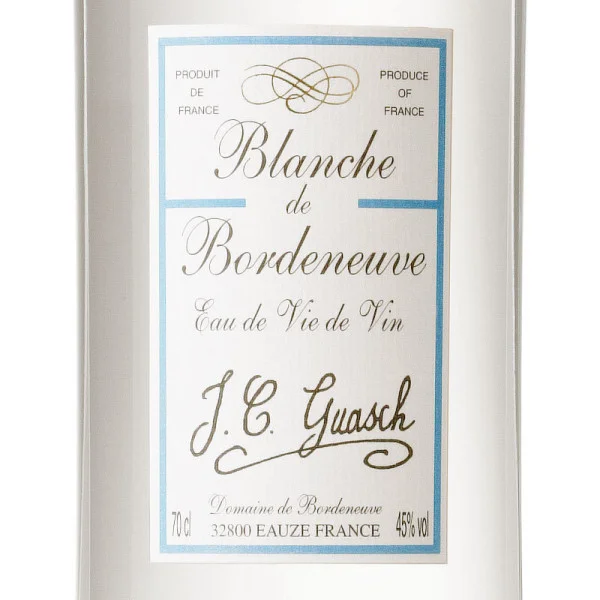
The house of Jean Cavé, in Lannepax, blends ugni blanc and colombard for a blanche with floral and fruity aromas, of white-fleshed fruit, with a spicy finish. At Château de Bordeneuve, the Guasch family distils in a column armagnac still: its blanche, at 45 % ABV, almost luminous in appearance, remains frank and broad on the palate and keeps the fruity scents of the grape. The estate also offers a Blanche au citron, with aromas of candied lemon and grapefruit.
Aromas and tasting
Without wood to round them off or mask them, the aromas of the wine and the grape variety come through directly: white flowers, pear, apple, fresh plum, almond, sometimes a peppery touch. Texture matters as much as scent: most of our producers describe a round, even smooth palate, which owes much to the slow reduction during maturation.
- Chilled: served very cold in a small glass, as an aperitif or at the end of a meal, for its purity;
- On ice: with an ice cube, as Castarède recommends;
- As a long drink: topped up with tonic, with a twist or a dash of lime juice;
- In cocktails: it happily replaces vodka or gin in the classics, with more fruit.
Blanche or cask-aged armagnac: which to choose?
It all depends on the moment. Blanche is an eau-de-vie of freshness, for aperitifs, cocktails or discovering the raw fruit of Gascon distillation. For a young armagnac that has already known oak, see our VS armagnacs; for the power of unreduced eau-de-vie after long years in cask, our cask strength armagnacs; for a specific year, our vintage armagnacs.
Frequently asked questions about Blanche d'Armagnac
What is Blanche d'Armagnac?
An AOC wine eau-de-vie from the Armagnac area, kept in an inert container and bottled without ageing in cask. It remains colourless and very aromatic.
What is the difference from traditional armagnac?
Armagnac is aged in oak casks for at least one year, and often much longer: it takes on an amber colour and notes of vanilla and wood. Blanche does not spend time in wood and keeps the fruit of the wine.
Which grape varieties are used?
Folle blanche, ugni blanc, baco and colombard, alone or blended. Delord, for example, chose a single variety, while Castarède blends three.
Who produces Blanche d'Armagnac?
On this page, six Gascon producers: Castarède, Delord, Dartigalongue, Clés des Ducs, Jean Cavé and Château de Bordeneuve. Each product page states the strength and bottle size.
Where can I buy Blanche d'Armagnac?
Right here: choose your bottle, add it to your basket and pay securely. Our team can help if you are torn between two styles.
Please enjoy responsibly. Excessive alcohol consumption is harmful to health.






 Jean Cavé
113 bottles
 Armagnac Delord
92 bottles
 Château de Millet
83 bottles
 Dartigalongue
76 bottles
 Baron de Sigognac
69 bottles
 Armagnac Castarède
63 bottles
 Clés des Ducs
48 bottles
 Château de Laubade
43 bottles
 Domaine de Pellehaut
28 bottles
 Château de Bordeneuve
17 bottles
 Charles de Granville
13 bottles
 Roger Groult
7 bottles