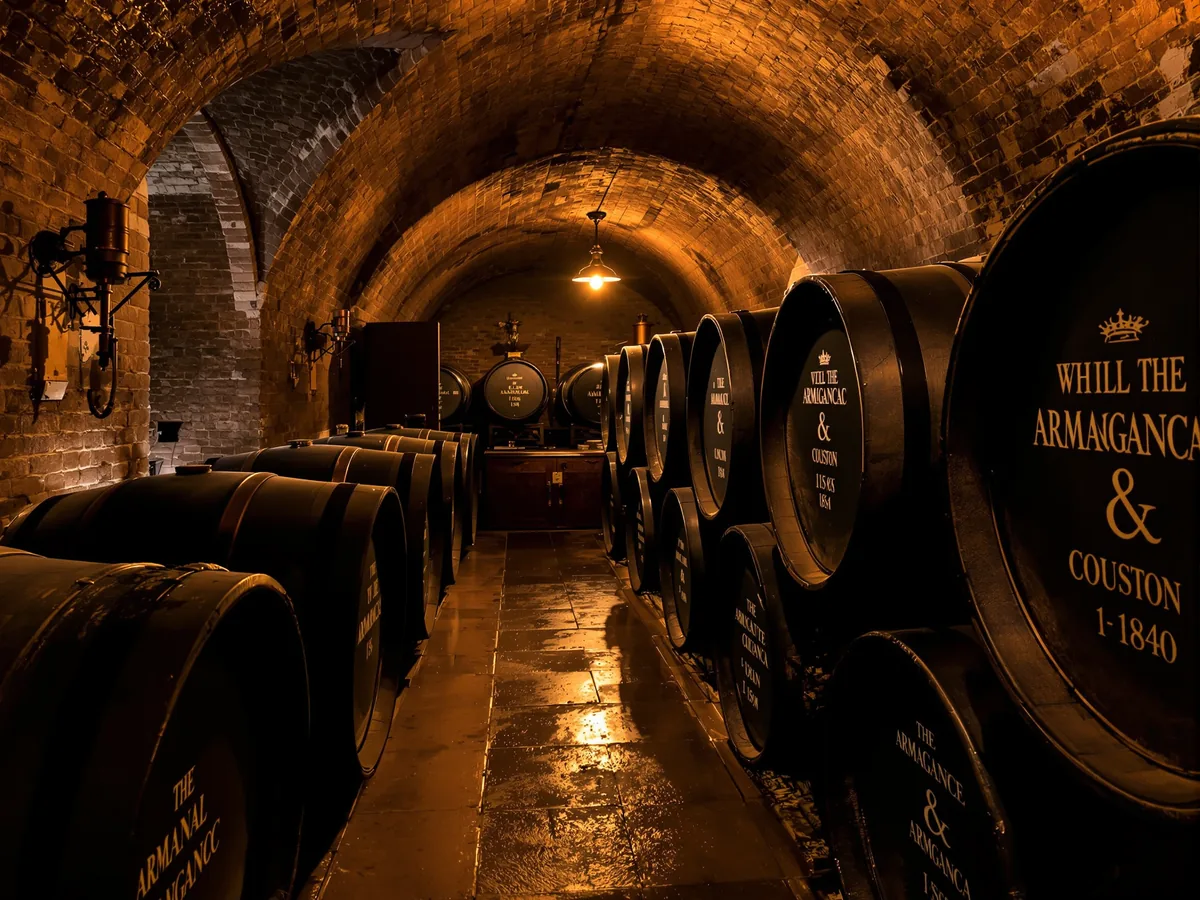

Armagnac or cognac? Both are French spirits, both are wine-based eaux-de-vie aged in oak casks, and both have been protected by an AOC since 1936. And yet, from vineyard to glass, almost everything sets them apart: the production area, the grape varieties, the still, the minimum ageing period, and the labelling conventions. Here are the real differences, drawn from the official specifications of each appellation, followed by a few pointers to help you choose according to your taste. We stock both, and we love them equally.
The difference between cognac and armagnac starts with the region
Armagnac comes from Gascony, in South-West France. Its production area covers communes in the Gers, the Landes, and the Lot-et-Garonne, between the Garonne, the Atlantic, and the Pyrenees, under a climate that shifts from oceanic to more continental influence. Cognac comes from the Charentes, further north in western France: its delimited region covers almost all of the Charente-Maritime, a large part of the Charente, and a handful of communes in the Dordogne and the Deux-Sèvres, under a temperate oceanic climate.
Each appellation divides its territory in its own way. In Gascony, three sub-appellations run from west to east: Bas-Armagnac, on sandy and boulbène soils; Armagnac-Ténarèze, in the centre; and Haut-Armagnac, on more clay-rich and calcareous soils. In the Charentes, the divisions are known as crus: Grande and Petite Champagne, on chalky clay-limestone soils; Borderies, on flinty soils; then Fins Bois, Bons Bois, and Bois Ordinaires. The designation Fine Champagne refers to a blend of the first two crus containing at least 50% Grande Champagne.
The grapes: what they share, and where they differ
Both appellations share three varieties: ugni blanc, folle blanche, and colombard. In the Charentes, ugni blanc dominates the vineyards by a wide margin. In Gascony, it shares the leading role with baco. Baco, selected in 1898 by Landes ampelographer François Baco, does not appear on the list authorised for Cognac, published in 2015.
Armagnac production may draw on up to ten varieties in total, including mauzac, jurançon, and meslier saint-françois. Cognac production lists six, including montils, sémillon, and folignan. Some Gascon houses offer single-varietal eaux-de-vie, such as the folle blanche bottled by Castarède or Pellehaut: a fine way to appreciate what the grape variety alone brings to the tasting.
The armagnac still and the Charentais double distillation
This is the sharpest distinction, and the key step that separates the two. Cognac is distilled in two stages, using a double distillation in the Charentais pot still: the first pass produces the brouillis, and the second, the “bonne chauffe,” produces the eau-de-vie. Armagnac is distilled primarily by continuous distillation, in a single pass through a copper column still with plates, heated over a naked flame. According to its official specifications, 95% of wines for distillation passed through this still in 2012. Double distillation remains permitted in Gascony, and a small number of houses favour it.
In both cases, distillation must be completed no later than 31 March following the harvest, using copper apparatus heated over a naked flame. The Gascon eau-de-vie leaves the column at between 52 and 72.4% vol. This relatively low alcoholic strength preserves a great many of the wine's compounds, which, according to the appellation's own specifications, accounts for its aromatic intensity and power on the palate.
Ageing, age statements, and vintages
Both are aged in oak casks, but not for the same minimum period: at least one year for armagnac, and at least two years for cognac. In both cases, age statements refer to the youngest eau-de-vie in the blend.
| Statement | Armagnac | Cognac |
|---|---|---|
| VS or three stars | at least 1 year | at least 2 years |
| VSOP | at least 4 years | at least 4 years |
| XO, Hors d'Âge | at least 10 years | at least 10 years |
Sources: the armagnac trade body (BNIA); the Cognac official specifications published in 2015, which express these thresholds in age counts (comptes).
Armagnac also has a strong tradition of vintage releases: an eau-de-vie from a single harvest year, which the trade body presents as a distinctly Gascon speciality. This is the spirit behind our vintage armagnacs, often chosen to mark a birth or an anniversary. Another particularity worth noting is Blanche Armagnac, a colourless eau-de-vie rested in inert containers: see our blanche d'armagnac selection.
The difference in flavour, in plain terms
The official specifications describe two broadly similar evolutions. When young, armagnac is warm, with aromas of fresh fruit, flowers, and wood; with age, it becomes rounder and more generous, moving towards cooked or candied fruit, spice, and rancio. When young, cognac shows floral and fruity notes, vine flower, pear; oak then brings vanilla or toasted character, followed by candied fruit, spice, and what tradition calls the “rancio charentais.”
The Gascon text links its continuous distillation to aromatic intensity and palate power; the Cognac text emphasises complexity and a particularly refined aromatic profile. That said, age and producer matter just as much as the appellation: always compare bottles of a similar age, a VSOP with a VSOP, an XO with an XO, paying attention to flavour, texture, and length. A cask strength armagnac (brut de fût), unreduced, retains the degree of its cask: check the label before drawing comparisons.
Cognac and armagnac: which to choose, and for what occasion
- For a gift tied to a specific year, a birth, a wedding, or an anniversary, a Gascon vintage is the most natural choice.
- To explore a precise terroir, look for a house that names it on the label, such as Dartigalongue in Bas-Armagnac or Château de Monluc in Armagnac-Ténarèze.
- For a rounded, complex digestif, compare an XO or Hors d'Âge from Gascony with a cognac of the same age category.
- For a first introduction, a cocktail, or cooking, a VS or a VSOP from Gascony will serve very well.
- If you are drawn to the Charentais style, our small cognac selection, signed by Gaston de Casteljac, offers the chance for a direct comparison.
Frequently asked questions
Which is better, cognac or armagnac?
Neither is inherently superior. They are two appellations governed by different rules, each producing outstanding eaux-de-vie. The right choice depends on your preference, the age you are looking for, and the occasion.
What is the main difference between cognac and armagnac?
Distillation: continuous and in a single pass for the great majority of armagnacs, and double distillation in the Charentais pot still for cognac. After that come the region, the permitted grape varieties, and the minimum time in cask.
Can armagnac be substituted for cognac in a recipe?
Yes. Both are wood-aged wine-based eaux-de-vie, and armagnac works perfectly well in cooking, flambéing, or cocktails. The flavour will differ slightly; for this purpose, a VS or a VSOP is perfectly adequate.
What fruit are they made from?
Grapes, in both cases: they are distilled from white wine made from the varieties authorised by each appellation.
To learn everything about Gascon eau-de-vie, read our guide what is armagnac, and to decode the label markings, our guide VS, VSOP, XO: how to read an armagnac label.
Alcohol should be enjoyed responsibly and in moderation.