
How is armagnac made? Described by its interprofessional body as the oldest brandy in France, this grape spirit comes into being in three stages: a white wine from Gascony, distillation in winter in a rather special still, then long years of ageing in oak casks. Every stage of production is governed by the specification (cahier des charges) of the Armagnac appellation, created by the decree of 6 August 1936, and each one leaves room for the skill of the grower, the distiller and the cellar master. This guide follows armagnac on its journey, from the harvest to the glass.
The stages of armagnac production at a glance
The production process always follows the same order, from the grape grower to the cellar master. The stages are:
- harvesting the grapes, white and picked early, within the AOC production area;
- winemaking, with no added sugar and no sulphites, for a light, acidic wine;
- distillation, before 31 March, most often just once, in a continuous process;
- ageing in oak casks, for at least one year, often much longer;
- blending and reduction, except for vintages and cask-strength (brut de fût) armagnacs;
- bottling, at a minimum of 40% vol.
All these stages take place in south-west France, where soil, climate and grape variety give each origin its own character, in an area covering the Gers and parts of the Landes and Lot-et-Garonne. The appellation is divided into three regions, Bas-Armagnac, Ténarèze and Haut-Armagnac, which are presented in our guide to armagnac terroirs.
From the harvest to the distilling wine
Everything begins in the vineyard. The white grapes used, mainly ugni blanc, baco blanc, folle blanche or colombard, are picked early, usually in October: the aim is fresh, acidic grapes rather than very ripe ones. Our guide to armagnac grape varieties presents each of them.
Winemaking is simple and natural. The specification permits only free-run juice, with or without press juice from the same harvest. It prohibits sugar enrichment and any use of sulphites, from harvest through to the finished wine. The resulting wine has a strength of between 7.5 and 12% vol.: low in alcohol and high in acidity, it keeps its freshness and waits naturally in vats until distillation. It is distilled on its fine lees, without the coarse lees.
Why such a light wine? Because distillation concentrates its aromas: the lower the wine's alcohol content, the more wine is needed for one litre of spirit, and the more of the fruit the spirit retains.
Armagnac distillation in winter, on the estate or with a travelling distiller
Distillation takes place during the winter following the harvest and must be completed by 31 March at the latest. This short window protects quality: a wine without sulphites must not be left waiting too long.
The wine is often distilled on the property. Many growers call on a travelling distiller, a Gascon tradition: the still moves from cellar to cellar through autumn and winter. Others entrust their wine to professional distillers or to cooperative cellars. A few examples from our houses:
- at Domaine de Laballe, the same travelling still has been coming to the estate since 1923;
- at Domaine de Danis, a travelling distiller sets up his wood-fired column every year;
- at Château de Bordeneuve, a copper armagnac still dating from 1921 runs day and night throughout the distilling season;
- at Castarède, distillation takes place in November, notably in a still built in 1942.
The armagnac still: continuous distillation
Around 95% of armagnac is distilled in the armagnac still, a piece of equipment unique to this spirit. It is a continuous still: wine flows in without interruption and the spirit flows out in the same way, for as long as the heating lasts.
The specification describes its components:
- a boiler, heated by a direct flame;
- a column with plates, fifteen at most;
- a wine heater and a condenser enclosing the coil.
The boiler, column, plates and coil are made of copper, a metal that helps remove undesirable compounds such as sulphur derivatives.
The Bureau National Interprofessionnel de l'Armagnac (BNIA), based in Eauze, describes how it works. Cold wine enters at the bottom of the condenser, where it cools the alcohol vapours travelling through the coil and warms up as it does so. It is then fed into the column, where it flows down from plate to plate to the boiler. Heated by the fire, vapours rise in the opposite direction and “bubble” through the wine on each plate: they pick up alcohol and most of the wine's aromas, then condense in the coil. The distiller adjusts the still according to the wine and the style of spirit he is aiming for.
Each armagnac house has its own ways: at Delord, the column has so-called “spider-leg” plates; at Domaine de Pellehaut, the boiler is wood-fired; Château de Laubade works with its own column, built in 1974.
A distillation technique born in the Middle Ages
Distilling the wines of Gascony is a very old practice. As early as 1310, Maître Vital Dufour, prior of Eauze, described the “forty virtues” of aygue ardente, or “burning water”. In the 14th century, wines from the “high country” struggled to reach the port of Bordeaux: distilling the white wine made it possible to preserve it and to cut transport costs. Trade with the Dutch, who were fond of brandies, then boosted production in the 17th and 18th centuries, and ageing in wood gradually developed.
Until the 18th century, distillation was carried out in pot stills, distilling twice. In the early 19th century, Tuilière, a stove maker from Auch, patented a continuous still, which local distillers adopted and refined: this column became the armagnac still. Also in the 19th century, merchants built dedicated cellars and steadily mastered blending and the monitoring of ageing. The full history of armagnac is told in our guide what is armagnac.
Double distillation, an exception in armagnac
The specification permits a second method: batch double distillation, in two heatings, in a still similar to the one used for cognac. It remains a minority practice, and every distillery must operate at least one armagnac still during the season. The BNIA notes that a few houses remain attached to this “double heating”.
This is one of the major differences from cognac, for which double distillation is the rule. Our comparison armagnac or cognac sets out the others.
Who makes armagnac? A few figures
The specification gives a snapshot of production as it stood in 2012: around 185,000 hectolitres of distilling wine, yielding 19,000 hectolitres of pure alcohol. Seventy per cent of production came from growers and cooperatives, and 30% from merchant houses. It is a spirit made on a small scale, in a land where vineyards sit alongside forests and livestock farming.
Both worlds meet in our cellar: estates that distil their own wine, such as Château de Laubade in Sorbets, and family-owned merchant houses that select, age and bottle spirits, such as Castarède.
At what strength does armagnac leave the still, and at what strength is it drunk?
As it leaves the armagnac still, the spirit measures between 52 and 72.4% vol. according to the specification, and most often between 52 and 60% vol. according to the interprofessional body. This relatively low strength retains a high level of aromatic substances: on the nose and on the palate, young armagnac is intense and long-lasting. With double distillation, the spirit comes off stronger, between 65 and 72.4% vol.
At this stage, armagnac is colourless, still fiery, already very fruity (plum, grape) and often floral (vine blossom, linden). This is the character found in Blanche Armagnac, also known as white armagnac, which rests for at least three months in an inert container without ever going into cask.
In the bottle, an armagnac must be at least 40% vol. Cask-strength armagnacs are bottled without added water, at their natural strength: according to the BNIA, this is generally between 40 and 48% vol. for vintages aged in a humid cellar, but it can be higher. Livelier young armagnacs can also be enjoyed in cocktails or over ice, as the interprofessional body suggests.
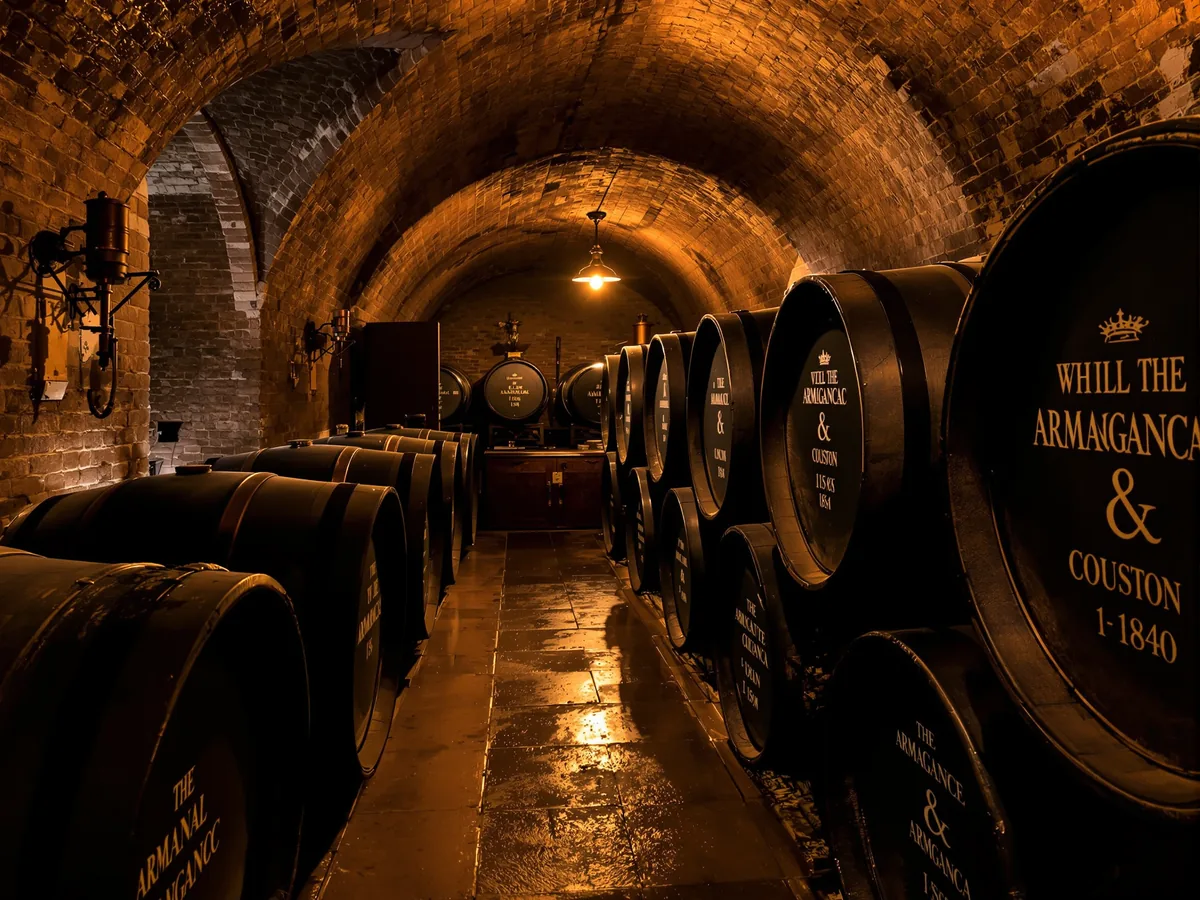
Ageing in oak casks
As soon as it is distilled, armagnac goes into cask. The specification requires at least one year of ageing in oak containers, counted from the 1 April following filling. The wood must come from sessile oak, pedunculate oak or a cross between the two.
The traditional container is the “pièce”, a cask of around 400 litres made from Gascon or Limousin oak. Spirits often start out in new casks, then move to older ones to avoid an overly pronounced woody taste. At Clés des Ducs, for example, time in new oak is limited to three or four months, to preserve finesse and fruit.
Several things happen in the cask at once: the oak releases its tannins and aromas, the spirit oxidises slowly through contact with the air that passes through the staves, and part of it evaporates. The woody notes become more refined, vanilla and prune appear, followed by the famous rancio, a flavour prized by connoisseurs: it is this slow maturation and long ageing that give armagnac its complexity. The colour shifts from amber to mahogany.
The cellar matters as much as the cask. The specification requires cellars reserved for ageing, closed and ventilated according to the weather. A humid cellar and a dry one do not produce the same spirits: at Château de Laubade, the team makes use of these differences, as it does of new and old casks, to refine its armagnacs.
The angels' share, demijohns and the “paradis”
Every year, part of the spirit evaporates through the wood: this is the “angels' share”. The strength falls slowly, by around half a degree a year according to the BNIA, and the armagnac becomes rounder.
When the cellar master judges that a spirit has reached its peak, sometimes after several decades, he takes it out of the wood and transfers it to a demijohn, a large glass bottle. It then barely changes at all. These demijohns rest in the “paradis”, the cellar's most precious heritage. At Jean Cavé, in Lannepax, as at Marcel Trépout, where the oldest spirits spend at least thirty years in cask, this stage is part of the house tradition.
Once bottled, armagnac no longer ages. It should be stored upright, so that the alcohol does not come into contact with the cork.
Types of armagnac: blends, vintages, cask strength
Finally comes the cellar master's work. Most armagnacs are blends: by tasting, he combines spirits of different ages, grape varieties or terroirs to achieve a consistent style. The age statement on the label then refers to the youngest spirit in the blend: at least one year for a VS, four years for a VSOP (Very Superior Old Pale), ten years for an XO (Extra Old) or a Hors d'Âge; our guide VS, VSOP, XO and Hors d'Âge explains them all.
Reduction then brings the spirit down to the strength chosen for bottling. It is done gradually, using “petites eaux”, a mixture of water and armagnac. During this finishing stage, the specification also permits colour adjustment with caramel, sweetening and the addition of an infusion of oak chips, known as “boisé”, within limits set by the text.
Two families are exempt from blending or reduction:
- vintage armagnacs, made from a single year, a speciality of armagnac: in Nogaro, the house of Dartigalongue ages each vintage separately;
- cask-strength armagnacs, bottled without added water.
Very old blends, now rare, are found among XO and Hors d'Âge armagnacs. Lastly, some armagnac is used to make Floc de Gascogne, the region's aperitif.
Frequently asked questions
How is armagnac made, in a nutshell?
White grapes picked early produce a light, acidic wine without sulphites. This wine is distilled before 31 March, most often just once, in the column-type armagnac still. The colourless spirit then ages for at least one year in oak casks, often much longer, before being blended or bottled as a vintage.
What is the alcoholic strength of armagnac?
At least 40% vol. in the bottle. The spirit leaves the still at between 52 and 72.4% vol., then its strength falls with time spent in cask and through reduction. Cask-strength armagnacs are drunk at their natural strength, often above 40% vol.
What is the armagnac still?
It is a copper continuous still, made up of a boiler heated by a direct flame, a column with plates and a coil. The wine flows through it without interruption. It is used to produce around 95% of armagnac.
How long is armagnac aged?
At least one year in oak casks, for every armagnac except Blanche. A VSOP is at least four years old, an XO at least ten, and old vintages may spend several decades in wood.
Does armagnac age in the bottle?
No. Armagnac only evolves in cask. It keeps the taste it had when it left the cask, provided it is stored upright.
To find out more, read what is armagnac and armagnac terroirs, or browse our full selection of armagnacs.
Alcohol abuse is dangerous for your health; please drink responsibly.